When Jesus cleared the outer courts of the temple it was about far more than what and who he was clearing out.
It was also about who He was making room to let in.
Jesus was clearing space to welcome
the foreigner
the poor
the oppressed
the discriminated
the marginalized.
The religious leaders of the day set up a system designed to keep people out, and put people down, in order to maintain and reinforce their own power. They were using exorbitant fees, gross exchange rates, and extra rules to enforce exclusivity and increase shame.
On what we now call Easter, Jesus continued the process of making space for inclusion as he announced his resurrection. Women at the time were so marginalized and devalued their testimony was not even considered credible in a court case. Yet it was women he first entrusted to tell his story.
The entire Passover celebration, from the preparation to the final glass of wine, reinforces the theme of liberation and the pull of slavery. The religious leaders of the day had turned what was intended as a celebration of liberation into an act of oppression. Every act of Jesus during Holy Week was intended to set the oppressed free once again.
I believe Jesus is still drawing people out of oppression, out of the ways we marginalize, judge and oppress each other.
Jesus also still seeks to rescue us from the slavery of the things we think will set us free.
For the past forty days as I’ve decluttered my stuff, I’ve had to process through new ways of thinking of how I interact with things, and what I prioritize: What’s out, what’s in? What oppresses and what sets free?
The past year+ of Covid19 has made many of us process through what we prioritize, what’s in, what’s out, what oppresses, what sets free?
I believe the story of Easter, and the entire life of Jesus, calls us to work through a similar process. What are we holding onto because it is tradition? What are we holding onto because it makes us feel comfortable? What are we holding onto that keeps us in power while making the marginalized, poor, foreigner and oppressed unwelcome in our spaces?
What are we holding onto that covers over real?
What are we willing to let go of to make space for others?
What are we prioritizing?
Who are we prioritizing, who are we giving power to, and who are marginalizing?
One of my favorite quotes, which has motivated me countless times in clearing space in my life, is from the forward of a book I read a number of years ago, during a communal Lenten Fast. It said,
“taking in, taking in, taking in. It clogs the soul.”
I think about this quote a lot.
It’s easy to think the answer to clogging our lives, homes and souls is to just stop taking in. Or to get rid of the clogs and stop there.
Which brings me from one of my favorite quotes…to what used to be my least favorite parable:
In these verses, as in so many other verses, Jesus was replying to Pharisees’ questions and accusations by offering them an illustration:
“When an impure spirit comes out of a person, it goes through arid places seeking rest and does not find it. Then it says, ‘I will return to the house I left.’ When it arrives, it finds the house unoccupied, swept clean and put in order.Then it goes and takes with it seven other spirits more wicked than itself, and they go in and live there. And the final condition of that person is worse than the first.”
I always hated this passage.
I figured at best, it was a reason not to bother cleaning. At worst, it was hopelessly depressing.
Either way, I missed the point.
Until someone sat with me and explained it in terms of nature abhorring a vacuum.
The person cleaning house stopped before a crucial point. They stopped at the emptying.
We see this all over:
We stop a time-consuming job or habit and the saved time automatically gets sucked up by something else.
Condemned buildings and abandoned lots are cleared out, with no plans for ongoing utilization of the space and they become overrun with drugs and crime.
We stop a bad habit, only to find we’ve replaced it with a worse habit.
It’s not enough to stop taking in.
It’s not enough to clean out.
It matters what we then fill the clearing with.
When Jesus overturned tables and cleared out the temple, he wasn’t simply getting rid of clutter.
It wasn’t about the “out.”
It was about the “in.”
It was about what, and more importantly WHO he was making space for.
I mean, as far as we know, he lived a pretty minimalistic life anyway, with no home and no real possessions that we know of.
Yet, he still spent Holy Week decluttering.
After his Palm Sunday donkey ride, Jesus went to the temple to clear out the obstacles which were getting in the way of worship. He overturned the tables of money changers and angrily shouted at the people exchanging goods. The temple’s purpose had been covered over with materialism, judgementalism, racism and legalism, which blocked the way for other nations to come worship. Many people clung to those practices as essential parts of their religion. To Jesus, they were cluttering up the space and covering over what was real.
That’s the core of what decluttering and minimalism are about: clearing space for what is most important, making room for what you prioritize.
Jesus spent Holy Week making space for what was most important and clearing out everything in the way.
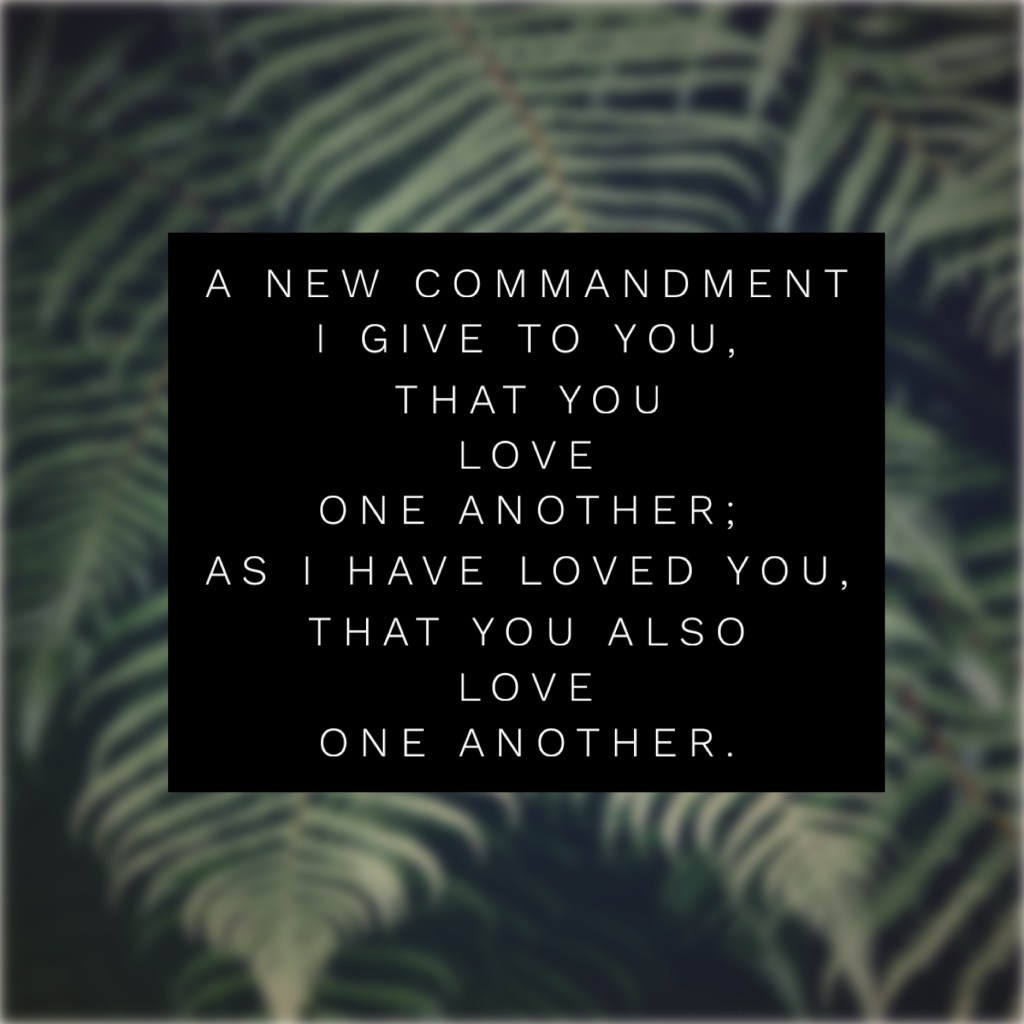
Today is the day traditionally known as Maundy Thursday, which means Command Thursday. Jesus entered the Passover Seder, a meal full of ritual and rules and reduced the rules down to one. He cut through hundreds of religious rules to bring focus to a single thought. A single command. A single example:
Clear the space. Keep it simple. Don’t get lost in all the clutter – just love others.
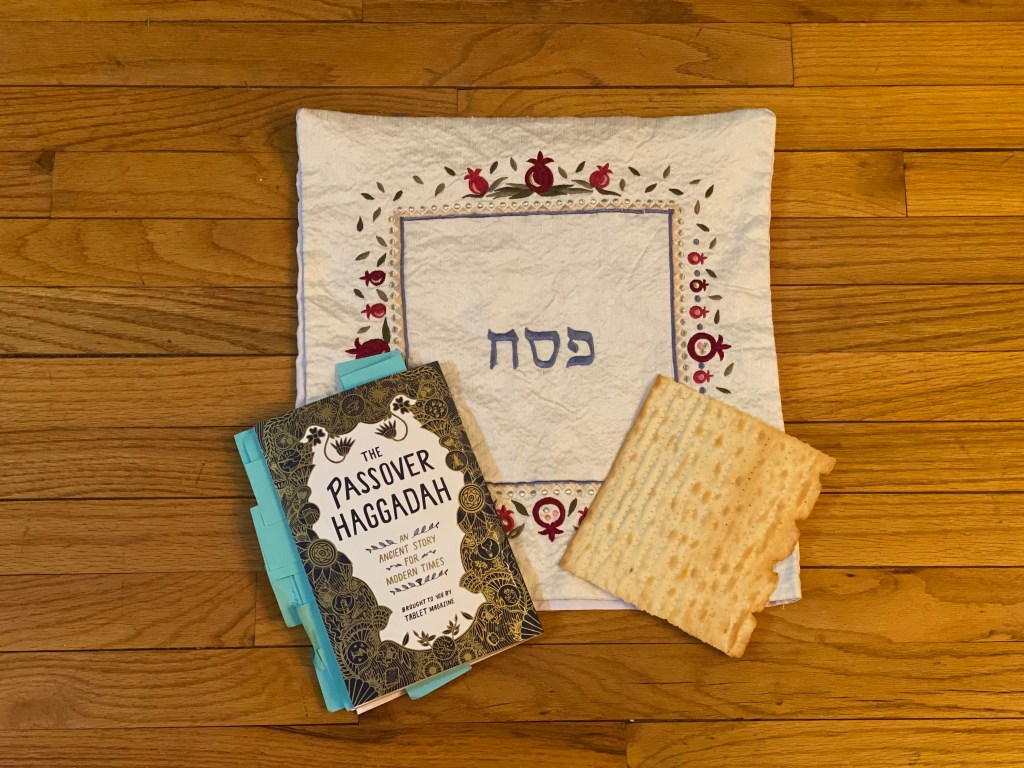
This past weekend, I hosted a Seder dinner. Like Lent, Passover and Seders have not traditionally been a part of my experience, so exploring the meaning and symbolism in each of them now opens up a bigger picture of God for me and a deeper understanding of faith.
Passover, and the Seder dinner, rehearse and celebrate the story of God’s deliverance of the Israelites from their slavery in Egypt. Over and over, throughout the ceremony, participants are invited to insert themselves in the story. It is deeply symbolic and overwhelmingly sensory.
For our Seder, I purchased a new Haggadah, the order of service providing a framework for the Seder, and spent time studying traditional and contemporary interpretations of the celebration. The Haggadah I purchased includes a number of tips, background information, and reflections to help hosts prepare for, and lead, the evening.
In preparation for Passover, people spend days, even weeks, readying themselves for the Seder meal, removing every crumb of chametz (forbidden foods containing leavening agents) from their homes.
My new Haggadah reflected on those preparations:
“In this postmodern age, Passover is, in part, about doing something hard – not eating what you’re used to and what you sometimes desperately crave – perhaps to prepare us for the difficult work that liberation unfortunately requires. And while Passover is not formally the holiday during which we do the big accounting of our souls, many a rabbi urges us to ‘search for the meaning behind the mitzvah’ of ridding our homes of chametz. Removing it ‘from our homes, our lives, our families, is a struggle between who we really are now and who we can be once we strip away all the trappings of self-importance,’ according to one source…In this moment, what we are asked to do by our tradition is to enact and in a small way reexperience a communal decision to leave enslavement behind.”
As I studied the Haggadah, I realized this is exactly the process I’ve been engaging in over the last few weeks –
The evaluation of the things in my home and my life
The struggle between who I really am now and who I can be
The journey from enslavement to freedom
The process of uncovering real.
Over the next several days I’ll continue to process through Passover, and the remaining days of Holy Week here, exploring the concepts of enslavement and freedom. I hope you’ll join me.
This week, I scheduled a technician for some work at our house. As I thought through where they would need to go in order to get their job done, I mentally started a checklist: Make sure they can safely get to the fuse box. Can they easily reach the other systems they need to access to get the job done? Where else might they need to go? A picture frame may need to be moved away from the fuse box, a rug may need to be rolled out of the way on the day they arrive, but in general, every access point I thought of was accessible.
No one would walk into my house and consider me a minimalist.
But if we had to have emergency services of any kind, I wouldn’t be distracted by needing to get a lot of things out of the way.
The daily work of decluttering and uncovering is not only benefiting how we live in our spaces each day, it’s also serving as preparation for emergencies and unforeseen circumstances.
A few years ago, someone left me a message left me know a building full of antique stores near me was closing up and getting rid of all their remaining inventory, free for the taking. By the time I heard about it and drove over, people were carrying the last remnants out to dumpsters. I parked my van and began making trips from the basement of the building to my van and back, racing against the dumpster fillers. There was no time to evaluate, so I beelined for the items I thought I could most use, mainly old scratched records, antique books and vintage boxes. I pulled away from the complex a little while later, covered in dust, my van bursting with treasure.
Later, when I experimented with selling repurposed creations, I used a number of the damaged treasures I had rescued for upcycled projects like wreaths, bowls, and plate stands. Most of the rest of the items have sat collecting dust in my basement since the day I brought them home.
As I went through some of those collections today, I found myself repeatedly saying, “oh, this so cool.”
I realized what I meant was, “how could I get rid of something with so much potential to be used in a new way, or displayed in a great space, or appreciated for it’s rich history?”
But they were stuck on a shelf, in my unfinished basement.
So, what if “but they’re so cool” meant instead:
“how could I keep something with so much potential to be used in a new way, or displayed in a great space, or appreciated for it’s rich history?
The tiny change in words was a huge shift in my mind set. I’m not appreciating or using those items while they sit on my shelf, and I can give them to someone who might.
It was so freeing.
90% of my unused vintage records, bins and other “treasures”? buh-bye.
Room to breathe, joyful spirit and clear shelves for my newly sorted kids memory boxes? hello!
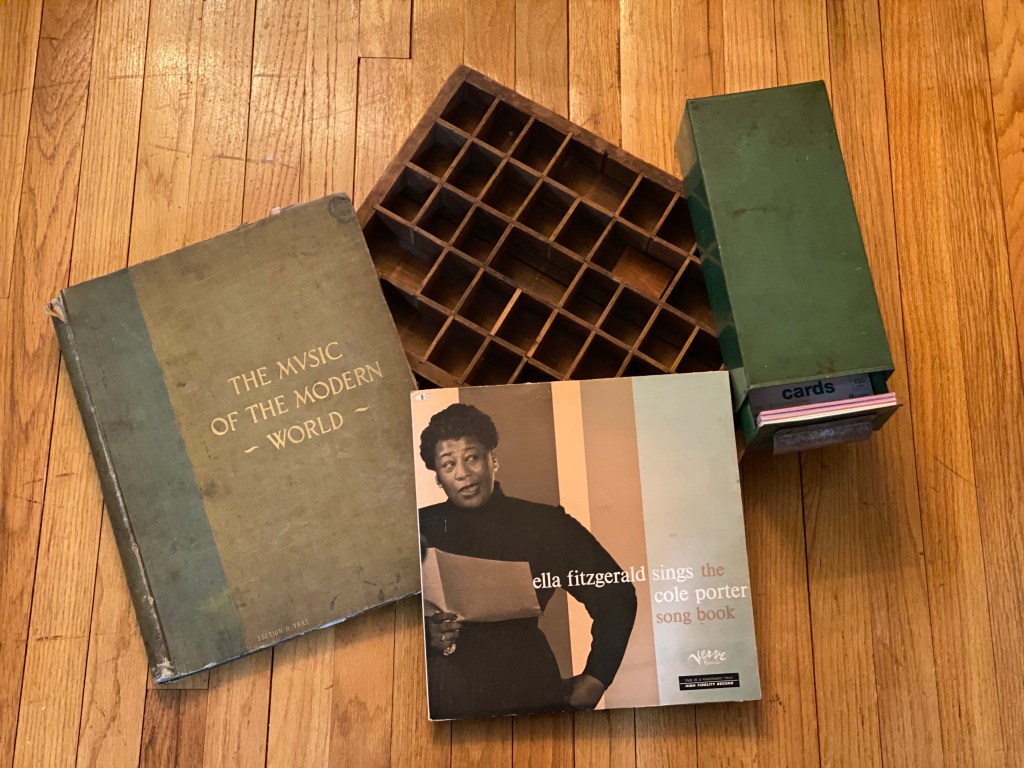
Image Contents: a few of my favorite vintage treasures. An Ella Fitzgerald record and file card box which have homes in my living room, so they’re staying; a letterpress tray and vintage music encyclopedias which do not, so they’re heading off to their new homes.
Even though minimalism experts like Joshua Fields Millburn and Joshua Becker talk about their decluttering process taking about three-quarters of a year, and other experts describe decades-long journeys, I figured six weeks should be enough time to get my house to clutter-free-a-place-for-everything-and-everything-in-its-place status. I mean, I’m not a hoarder. I don’t have a storage unit. My basement is a disaster, but I can park in the garage. Usually.
When I started, I felt I landed pretty squarely in the “normal” range of clutter, on the scale I made up. In my head. Based basically on my house not looking like either an episode of Hoarders or a minimalist magazine cover.
So today, six weeks into my decluttering journey, when I went to put a few things away and realized they didn’t have an easy permanent home, I was frustrated at myself. And when I gathered up a few things in a tote to “deal with tomorrow,” I felt guilty and ashamed. Hadn’t I just learned the lesson of “do it now” yesterday?
When am I going to reach the point of everything having a home and automatically putting it there?
Then I remembered two things. First, the “onion method.” Different people have different versions of what this means, but the concept always revolves around layers. Sometimes the layering is in a single decluttering session – like yesterday when Dana K. White’s method started with trash and the easy peasy stuff, then kept going through harder items.
Sometimes uncovering the layers happens over time.
A month ago, I decluttered my reusable grocery bags. Today I went grocery shopping and realized, since I’m not stocking up on grocery items as heavily, I’m shopping for less, and therefore don’t need as many bags as I had narrowed it down to a few weeks ago.
I started with what I thought I needed, then was able to peel back more.
The same thing is happening in the rest of my home. As I enjoy the benefits, see how I’m actually living, and build up my decision-making muscles, I’m often decluttering things as I come across them, and sometimes intentionally going back to spaces I know can function better with less.
I also realized everything not yet having a place for everything and putting a few things in a tote for tomorrow is not failure. There’s grace in the process. After all, I have a whole other week before my self-imposed deadline. 😉
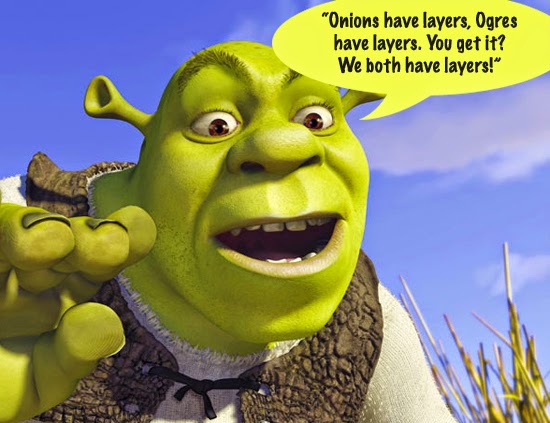
Image Contents: an image of Shrek saying, “Onions have layers, Ogres have layers. You get it? We both have layers!” Because I can’t talk about onions having layers with Shrek and Donkey busting into my head.
I’ve ingested quite a number of books, blogs, podcasts and youtube videos on decluttering and minimalism. (Oh the irony of my consumption of minimalism media.)
I’ve gleaned a number of things which work for me (timers are an essential part of my routines) and things which don’t (no, I don’t think the answer to a messy house is to just stick everything you have in baskets).
There is one decluttering method I’ve come across in a few places. I hate almost everything about it. Except: it works really well and solves a lot of the problems I create for myself, and apparently it’s just about perfect for me. But, you know, other than that…
Mostly I don’t like it because it goes against how I usually declutter. But how I usually declutter leaves me exhausted and often leaves my house in worse shape than when I started, so… I decided maybe it was worth trying… for research.
The method is from Dana K. White of A Slob Comes Clean. She has multiple blog posts, youtube videos and books detailing what she’s learned over the past decade or so of her journey, I’m just going to highlight her method of “decluttering without making a bigger mess.”
Here’s what she says you need to get started:
1st: a donate-able donations bag/bin. (so you can just put the whole bag in the car and drop it off at a donation center.)
2nd: a garbage bag
3rd: your feet or someone helping you if you need assistance (yeah, it’s a little cheesy, but she’s going somewhere with it, so I’m including it)
During your decluttering session you’re going to stick to a small, defined area and ask yourself two questions as you go:
If I needed this item, where would I look for it? (take it there. now.)
If I needed this item, would it ever occur to me that I already have one? (If not, get rid of it because I’d just buy a new one if I needed it.)
It’s her parenthesied directions that get to me:
Why would I take it there immediately? It breaks up the process! I’d get distracted! I can’t imagine how tired I’d be if I stopped with every item to put it somewhere else and came back! I’ll just make a pile as I go.
The second question is not as difficult for me, but I still feel the arguments rise up inside: What a waste of money! It’s a perfectly good item! Why would I buy a new one when I have one?!
But I tried it anyway.
Normally my decluttering process is more like:
dump everything out. sort every single item. get distracted. come back. look through the piles to remember what the sorting method was. get distracted. come back. finish sorting everything. feel accomplished but tired. look around and see scattered piles of donate, garbage, keep, bring to another room, etc. feel overwhelmed and frustrated with myself.
Sometimes the piles would get addressed right then. Sometimes I’d need to move on to something else and the piles would linger, becoming magnets for more clutter and more frustration.
So today, I picked one drawer and implemented the rules. She encourages you to start with the easiest stuff – usually trash. I didn’t have any obvious trash in the drawer, but found plenty of things which needed to be delivered to other places. I love her first question because it’s totally real, not aspirational and unattainable. You’re not designing a whole organizing system and creating places for something. You’re acknowledging how you actually operate. If she asked me where my favorite multi-bit screw driver belongs, I might be tempted to think about places on the workbench I should keep it. When she asks where I would I look for it, my immediate answer is, “the kitchen drawer.” Ok, so don’t beat yourself up over whether that’s the right answer or not, go put it in the kitchen drawer! If there’s not room in the kitchen drawer, get rid of one thing in the kitchen drawer and now you have room.
I still found it hard to deliver the items immediately. I was tired. I repeatedly found myself going to make a pile of something. But I forced myself to do it – looking around first to see if there was anything else I could take at the same time to save a trip. At one point the phone rang and I left to go answer it somewhere else. When I came back to the drawer, all that waited for me was an empty garbage bag, a partially filled donate bag and progress. Nothing totally dumped out. No piles. No mess. I could walk away right then and it would be better than I started.
This is the beauty of Dana’s method. You’re always at a stopping point and your stopping point is always better than when you started.
So like I said, I hate almost everything about it. Except it works really well, solves a lot of the problems I create for myself, and apparently it’s just about perfect for me.
Image Contents: What my spaces often look like AFTER I declutter – random piles of stuff that need to be delivered to other places, often tossed in bags that sit in the hall or basement until I set aside time to deal with the items inside. again.



 Uncovering Real