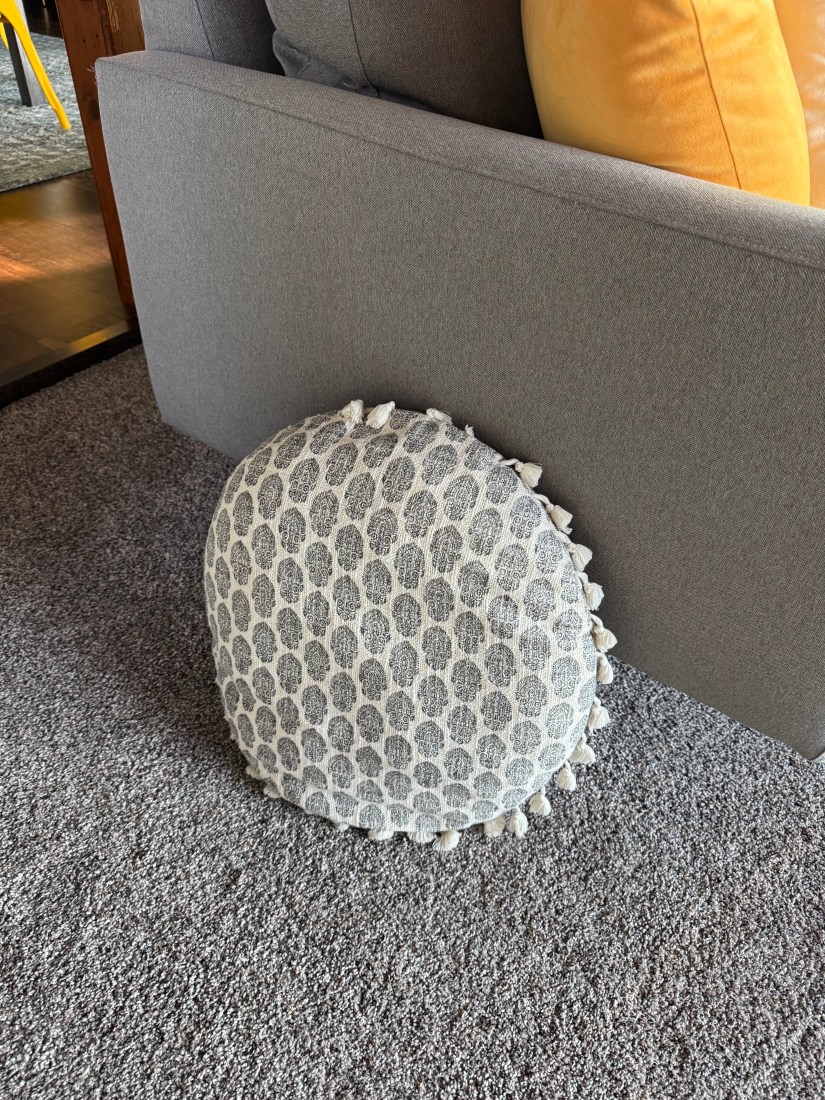
When we sit down on the couch, my partner and I both move a pillow. Without thinking, at least one ends up on the floor every day. Then, when we get up, we have to remember to put it back.
What if instead of treating this like another micro task on our mental to do list, I see it as a little hint:
Like the couch is quietly whispering: “You really don’t need four pillows.” (Even if they are really cute.)
Maybe this doesn’t need a big evaluation or thought process. Maybe the pillows that keep ending up on the floor are the ones we never choose. And maybe, instead of putting them back on the couch again, I could pick them up, put them in the donate bin, and never have to pick them up off the floor again.
What other simple clues are scattered around our homes, just waiting for us to notice?
I’ve ingested quite a number of books, blogs, podcasts and youtube videos on decluttering and minimalism. (Oh the irony of my consumption of minimalism media.)
I’ve gleaned a number of things which work for me (timers are an essential part of my routines) and things which don’t (no, I don’t think the answer to a messy house is to just stick everything you have in baskets).
There is one decluttering method I’ve come across in a few places. I hate almost everything about it. Except: it works really well and solves a lot of the problems I create for myself, and apparently it’s just about perfect for me. But, you know, other than that…
Mostly I don’t like it because it goes against how I usually declutter. But how I usually declutter leaves me exhausted and often leaves my house in worse shape than when I started, so… I decided maybe it was worth trying… for research.
The method is from Dana K. White of A Slob Comes Clean. She has multiple blog posts, youtube videos and books detailing what she’s learned over the past decade or so of her journey, I’m just going to highlight her method of “decluttering without making a bigger mess.”
Here’s what she says you need to get started:
1st: a donate-able donations bag/bin. (so you can just put the whole bag in the car and drop it off at a donation center.)
2nd: a garbage bag
3rd: your feet or someone helping you if you need assistance (yeah, it’s a little cheesy, but she’s going somewhere with it, so I’m including it)
During your decluttering session you’re going to stick to a small, defined area and ask yourself two questions as you go:
If I needed this item, where would I look for it? (take it there. now.)
If I needed this item, would it ever occur to me that I already have one? (If not, get rid of it because I’d just buy a new one if I needed it.)
It’s her parenthesied directions that get to me:
Why would I take it there immediately? It breaks up the process! I’d get distracted! I can’t imagine how tired I’d be if I stopped with every item to put it somewhere else and came back! I’ll just make a pile as I go.
The second question is not as difficult for me, but I still feel the arguments rise up inside: What a waste of money! It’s a perfectly good item! Why would I buy a new one when I have one?!
But I tried it anyway.
Normally my decluttering process is more like:
dump everything out. sort every single item. get distracted. come back. look through the piles to remember what the sorting method was. get distracted. come back. finish sorting everything. feel accomplished but tired. look around and see scattered piles of donate, garbage, keep, bring to another room, etc. feel overwhelmed and frustrated with myself.
Sometimes the piles would get addressed right then. Sometimes I’d need to move on to something else and the piles would linger, becoming magnets for more clutter and more frustration.
So today, I picked one drawer and implemented the rules. She encourages you to start with the easiest stuff – usually trash. I didn’t have any obvious trash in the drawer, but found plenty of things which needed to be delivered to other places. I love her first question because it’s totally real, not aspirational and unattainable. You’re not designing a whole organizing system and creating places for something. You’re acknowledging how you actually operate. If she asked me where my favorite multi-bit screw driver belongs, I might be tempted to think about places on the workbench I should keep it. When she asks where I would I look for it, my immediate answer is, “the kitchen drawer.” Ok, so don’t beat yourself up over whether that’s the right answer or not, go put it in the kitchen drawer! If there’s not room in the kitchen drawer, get rid of one thing in the kitchen drawer and now you have room.
I still found it hard to deliver the items immediately. I was tired. I repeatedly found myself going to make a pile of something. But I forced myself to do it – looking around first to see if there was anything else I could take at the same time to save a trip. At one point the phone rang and I left to go answer it somewhere else. When I came back to the drawer, all that waited for me was an empty garbage bag, a partially filled donate bag and progress. Nothing totally dumped out. No piles. No mess. I could walk away right then and it would be better than I started.
This is the beauty of Dana’s method. You’re always at a stopping point and your stopping point is always better than when you started.
So like I said, I hate almost everything about it. Except it works really well, solves a lot of the problems I create for myself, and apparently it’s just about perfect for me.
Image Contents: What my spaces often look like AFTER I declutter – random piles of stuff that need to be delivered to other places, often tossed in bags that sit in the hall or basement until I set aside time to deal with the items inside. again.

 Uncovering Real