The Raccoon Rule

I was reminded of why I declutter through an unexpected visitor this week.

A very unexpected visitor.

Early one morning, I woke to some commotion in the kitchen. Assuming it was a child, I went to check it out  but instead of a child, I  found our living room window screen pushed in and several items from the counter between the kitchen and living room scattered across the floor.

After catching my breath and calling my husband out, we discovered the cutest little bandit I’ve ever seen had broken in, stolen a scone off the counter, and was now sitting on the deck, happily unwrapping and eating her bounty.

Meet Buttercup:
(Bonus points if you know the reference to the Queen of Refuse, the Queen of Garbage.)

Our Raccoon Bandit

Once we made sure there were no more critters hiding in the house and re-secured the window, I looked at the chaos Buttercup had left behind. I was grateful the mess wasn’t worse. Keeping my house from getting out of control definitely helps make unexpected situations like these easier to deal with!

But there was still a mess to deal with. A tray she knocked to the floor had held our HomePod speaker and a few sentimental keepsakes: a set of ceramic ducks from my grandmother, who passed away last year, and George, a clay monkey my daughter made in school years ago.

Two of the three ducks were shattered. George had lost multiple limbs.

As I stood there with broken pieces in my hands, I paused. 

You may have heard of the “poop rule” when it comes to decluttering:
“Do you like this item enough that you’d clean poop off of it to keep it?”

Well, I now had a new version: The Raccoon Rule.
Would I clean, fix, and keep something a raccoon got her paws on?

It was tempting to toss them out. They were damaged. The mess was inconvenient. But these weren’t just random knick knacks – they were items I had chosen to keep.

And that’s the heart of decluttering for me.

My decluttering isn’t really about getting rid of stuff.
It’s not about what I’m losing.
It’s about what I’m keeping.
And what I’m gaining, including the joy from seeing our memories displayed around us. 

I had kept those items because they are filled with happy memories — sweet treasures that make me smile when I see them.

So I picked up the pieces, sanitized them, and plan to glue them back together.

Decluttering, to me, has never been about living with nothing.
It’s about living with intention.
It’s about creating a space that is manageable, and it is also about creating space for what matters – and having room to appreciate the joy in what stays: 

Like a one-armed clay monkey named George, who now has a few scars and a great story to tell.

This Week I’m Trying: The Purse Box

Like most of my possessions, I have curated my purses down from what I unconsciously collected over the years, to an amount somewhere between a maximalist’s dream and an amount that would still suffocate a minimalist.

In my bag collection, there’s:
– my lunch bag that doubles as my work purse
– a vintage airline bag that fits my iPad and flute (for when I’m singing/playing)
– four other purses I use throughout the year
– and a few specialty bags that I don’t use regularly, but still made the cut: a book bag, some evening clutches, etc.

Listen, I never said I was a minimalist. 🙂 

Some bags are always ready to go. My singing bag and my lunch bag stay stocked because I use them for the same activities over and over. A long time ago, I created a little system for the less-used bags: I tucked them away with a single makeup bag filled with odds and ends I might want to toss in – like that super-slim hand sanitizer from a conference that perfectly fits into an evening clutch.

 I once decided I could streamline getting ready and cut down on decision making by keeping my other purses stocked like my singing and lunch bags.  I lined up my 4 everyday handbags and stocked each one with duplicates of my go-to items: tissues, chapstick, hand sanitizer, etc. I figured this way I could just grab and go.

But… not so much.

Every time I grabbed a bag, I ended up rechecking it anyway – wondering if I’d borrowed something from it or deciding in the moment I wanted a different flavor of lip balm (maybe a tinted one, because I’m fancy today). I always reshuffled. I spent more time getting ready than I would’ve if I hadn’t pre-stocked at all.

Then I saw someone online talk about their “purse box” – a small box in their closet where they dump everything out of their purse when they get home. The next time they go out, they take whatever purse they want,  and re-pack from the box.

It hit me like a stroke of genius…even though I’d basically already been doing this with my evening bags for years.

What I realized is that this system fits how my ADD  brain works:  stockedish. readyish.

It’s the same reason I don’t usually prep whole freezer meals. Instead, I double up on cooked meat or roasted veggies, freeze the extras, and figure out later what I’ll use them for. I like being flexibly prepared. I want ease, but I need options.

Here’s why I think the purse box could work for me:

  1. It lets me choose in the moment. The elements are ready, but I still get that spark of decision: which bag works with my day? Am I going to need to reapply sunscreen?
  2. It keeps me connected to my stuff. For some people, re-touching every item might feel tedious. But for a brain like mine that struggles with object permanence, physically putting each thing into my purse helps assure me that I have it.

So this week, I’m trying the purse box.

Not because it’s the “right” system. Not because it’s aesthetic or efficient or something a professional organizer would recommend.

But because it makes sense to me.

It’s one more reminder that the best systems aren’t the ones that work in theory – they’re the ones that actually work for me, in real life, with my actual brain.

Even when it means creating a glorified junk drawer, because it’s not about doing what’s supposed to work. It’s about utilizing what’s really helpful.

Don’t Crowd the Mushrooms

The only line I remember from the movie “Julie and Julia” is

“Don’t crowd the mushrooms”

In case you haven’t seen the movie, or heard this culinary wisdom, here’s the gist:

Mushrooms are full of water

When you heat them up, their water is released as steam.

If you pack too many mushrooms in a pan, their collective steam has nowhere to go, creating a hot tub that steams mushrooms into mushy little blobs.

But if you give them room, the air can flow, the steam can dissipate, the mushrooms can brown and they caramelize into yummy goodness.

Good gravy, I love a good metaphor:

When we crowd our physical spaces, our things can literally change, too. 

It’s harder to dust and to clean, and the clutter can invite must, mildew, or other nastiness.

But even if we’re able to keep our stuff clean, overcrowding doesn’t allow space to breathe and shine.

Listen.

Design-wise, I’m a maximalist.

I love a collection. A gallery wall.  Why have one plant when you can host a party of plants?

Abundance is definitely one of my joy languages. But when my “collections” get overcrowded, they stop shining. They blur. And like steamy mushrooms, my display can turn into a mushy gray blob.

Don’t crowd the mushrooms.

Leave (or make) a little room to breathe, to let off some steam, and let the goodness develop.

Whew, I love a metaphor with layers:

When we overcrowd our lives, the same process happens. We can go through actual physical changes. It’s harder to breath, to think, and to process, and the lack of space can breed all sorts of nastiness (nasty health, nasty attitudes, etc.)

We need a little margin in our life, places (as Seth Godin says) to “put our tired.” 

Space to let off our steam so we don’t turn into mushy gray blobs.

What can you pull out of your space, your calendar, or your mental/emotional load today to make some room to breathe and let goodness develop?

Don’t Crowd the Mushrooms!

Inviting my ADD to the Process

I’ve been a fan of Dana K. White’s decluttering strategies for years. She speaks to my ADD brain in a language it can actually hear and process. One of the main parts of her strategy involves asking yourself 2 decluttering questions as you hold each item you pick up:

  1. If I needed this item, where is the first place I would look for it?
    1. Go put it there now
  2. If I needed this item, would it occur to me that I already own it?
    1. (If not, donate it now)

I’ve recently added a question of my own to this list:

If I didn’t have this item what could I do?

Some things – like keys – are easy to answer. I legitimately need these items and they need to have a place in my home. If I didn’t have them I would need to replace them. Some things are not so obvious -like a scrap of fabric.

I’m a creative person and my creativity runs overtime when I am decluttering. I can look at a scrap of fabric and imagine 47 projects I would definitely need that.exact.piece of fabric to complete. I couldn’t possibly get rid of it. I might even know the answer to Dana’s decluttering question 1:  in the drawer of my craft dresser with the 389 other pieces of fabric. 

Often when I’ve decluttered in the past, I’ve tried to turn off that creative feature in my brain. I tell it to stop imagining possibilities because I thought that’s what I needed to do in order to work the decluttering process.

Creatives tend to feel a lot of pushback on being creative.

{People with ADD are way more likely to receive negative feedback and more prone to store it longer in their brain and bodies.}

I have been mocked for my creativity. 

And I have done a LOT of work to get to the point where I can say:

“I Like my creative brain. I LOVE my creative brain.” 

When I approach the decluttering questions with the mindset that I need to shut down my creative brain, my inner ADD bristles and balks and remembers every time someone treated me like crap for being creative and suddenly I am working overtime on creating 47 projects I would definitely need that exact piece of fabric to complete.

Instead, 

What if honoring my creativity is exactly what I need to help me declutter? What if I shift the question a bit?

I love repurposing items. I once created a business selling upcycled items.

I’ve made lamps out of flutes, flowers out of playbills, and I can make a planter out of almost anything. 

I’ve typically used that creativity to look at an item and say, “What could I use this item for?”

Which leads to me keeping piles of suitcases filled with random “potential.”

Now I’ve started asking, “If I didn’t have this item, what could I do/use?”
For example:

If I was picking up an empty planter I could ask: If I didn’t have this planter, and I needed to plant a new plant, what could I use?

I’m very confident that my amazing creative brain could find something to turn into a planter and I probably don’t need this planter. And if not, I could likely find one in minutes by asking a neighbor or my Buy Nothing group on Facebook. (I also DEFINITELY do not need another plant to put in a planter, but that’s a post for a different day.)

When I clean out my kitchen cabinets, I used to say, “I need this serving tray because this is what I use for…..”

Now I ask,  “If I didn’t have this, what would I use?”

Maybe I would pull the wood tray that’s under my coffee pot out for serving that dish, then put it back when I’m done.

Instead of telling my creative brain to sit down and shut up,

I’m inviting it to the process.

Honoring it.

Recognizing how important and amazing it is. 

My ADD brain has been told to sit down and be quiet often enough. I’m excited to show I love it more.

Side Quests and Signal Flares

When I feel stressed I like to reorganize my closets.

Especially my master bedroom closet.

Weird? Maybe. Pointless? definitely not.

It can be a helpful process.

I can feel accomplished at the end. Like a good painting project, I can look at my room at the end and say, “I did that.”

But in order to say “I did that” – it needs to actually get done. 

I have a tendency to embark on projects with uncontained enthusiasm. I start strong, either motivated by a goal (“Today’s the day I get this basement ‘organized’”) or motivated by an emotion (any stress or rage cleaners out here?)

Orrrr

I start on a project because in the moment it seems like an absolutely necessary side quest from the path I’m on. Like, I’m getting dressed but can only find one of this earring set? Why wouldn’t I dump out every piece of jewelry I own and start reorganizing the whole system until I am sitting on the floor half dressed, surrounded by 30 carefully sorted piles of jewelry, completely out of energy, and 17 searches deep on the Best Jewelry Storage Systems on TikTok and Amazon?

Actually, that’s the path most of my projects tend to take. Big energy start, a swirl through overthinking and distraction, then an overwhelming crash that leaves me with a bigger mess than I started with.

Not exactly a remedy for stress and uncertainty. 

And when I’m stressed, I like to reorganize my closets. Notice a pattern?

Stress leads to action, which feels productive – until it spirals. I want to feel in control, so I dive into something I can control. But then the thing I thought would soothe me ends up adding to the chaos.

I’m learning the urge to reorganize is a flag – a signal that something inside me is asking for attention, for care, for clarity.

Lately, I’ve been trying to pause when I feel this signal flare. Instead of pushing through, I’ll ask myself: “What did I really need when I started this?” 

Sometimes it’s control. Sometimes it’s rest. Sometimes it’s just a sense of forward motion.

And sometimes it’s a better system for managing my bedroom closet. And that’s ok, too.

(check out pictures of my latest bedroom closet side quest on Instagram)

Easter Reflections: Who Lives, Who Dies, Who Tells Your Story

When Jesus cleared the outer courts of the temple it was about far more than what and who he was clearing out.

It was also about who He was making room to let in.

Jesus was clearing space to welcome

the foreigner

the poor

the oppressed

the discriminated

the marginalized.

The religious leaders of the day set up a system designed to keep people out, and put people down, in order to maintain and reinforce their own power. They were using exorbitant fees, gross exchange rates, and extra rules to enforce exclusivity and increase shame.

On what we now call Easter, Jesus continued the process of making space for inclusion as he announced his resurrection. Women at the time were so marginalized and devalued their testimony was not even considered credible in a court case. Yet it was women he first entrusted to tell his story.

The entire Passover celebration, from the preparation to the final glass of wine, reinforces the theme of liberation and the pull of slavery. The religious leaders of the day had turned what was intended as a celebration of liberation into an act of oppression. Every act of Jesus during Holy Week was intended to set the oppressed free once again.

I believe Jesus is still drawing people out of oppression, out of the ways we marginalize, judge and oppress each other.

Jesus also still seeks to rescue us from the slavery of the things we think will set us free.

For the past forty days as I’ve decluttered my stuff, I’ve had to process through new ways of thinking of how I interact with things, and what I prioritize: What’s out, what’s in? What oppresses and what sets free?

The past year+ of Covid19 has made many of us process through what we prioritize, what’s in, what’s out, what oppresses, what sets free?

I believe the story of Easter, and the entire life of Jesus, calls us to work through a similar process. What are we holding onto because it is tradition? What are we holding onto because it makes us feel comfortable? What are we holding onto that keeps us in power while making the marginalized, poor, foreigner and oppressed unwelcome in our spaces?

What are we holding onto that covers over real?

What are we willing to let go of to make space for others?

What are we prioritizing?

Who are we prioritizing, who are we giving power to, and who are marginalizing?

Friday Reflections: Out and In

One of my favorite quotes, which has motivated me countless times in clearing space in my life, is from the forward of a book I read a number of years ago, during a communal Lenten Fast. It said, 

“taking in, taking in, taking in. It clogs the soul.”

I think about this quote a lot.

It’s easy to think the answer to clogging our lives, homes and souls is to just stop taking in. Or to get rid of the clogs and stop there. 

Which brings me from one of my favorite quotes…to what used to be my least favorite parable:

In these verses, as in so many other verses, Jesus was replying to Pharisees’ questions and accusations by offering them an illustration: 

 “When an impure spirit comes out of a person, it goes through arid places seeking rest and does not find it. Then it says, ‘I will return to the house I left.’ When it arrives, it finds the house unoccupied, swept clean and put in order. Then it goes and takes with it seven other spirits more wicked than itself, and they go in and live there. And the final condition of that person is worse than the first.”

I always hated this passage.

I figured at best, it was a reason not to bother cleaning. At worst, it was hopelessly depressing.

Either way, I missed the point. 

Until someone sat with me and explained it in terms of nature abhorring a vacuum. 

The person cleaning house stopped before a crucial point. They stopped at the emptying. 

We see this all over:

We stop a time-consuming job or habit and the saved time automatically gets sucked up by something else.

Condemned buildings and abandoned lots are cleared out, with no plans for ongoing utilization of the space and they become overrun with drugs and crime.

We stop a bad habit, only to find we’ve replaced it with a worse habit. 

It’s not enough to stop taking in.

It’s not enough to clean out.

It matters what we then fill the clearing with.

When Jesus overturned tables and cleared out the temple, he wasn’t simply getting rid of clutter. 

It wasn’t about the “out.”

It was about the “in.”

It was about what, and more importantly WHO he was making space for. 

Week 6, Day 4: “How Could I Keep it”

A few years ago, someone left me a message left me know a building full of antique stores near me was closing up and getting rid of all their remaining inventory, free for the taking. By the time I heard about it and drove over, people were carrying the last remnants out to dumpsters. I parked my van and began making trips from the basement of the building to my van and back, racing against the dumpster fillers.  There was no time to evaluate, so I beelined for the items I thought I could most use, mainly old scratched records, antique books and vintage boxes. I pulled away from the complex a little while later, covered in dust, my van bursting with treasure.


Later, when I experimented with selling repurposed creations, I used a number of the damaged treasures I had rescued for upcycled projects like wreaths, bowls, and plate stands. Most of the rest of the items have sat collecting dust in my basement since the day I brought them home.

As I went through some of those collections today, I found myself repeatedly saying, “oh, this so cool.” 

I realized what I meant was, “how could I get rid of something with so much potential to be used in a new way, or displayed in a great space, or appreciated for it’s rich history?”

But they were stuck on a shelf, in my unfinished basement.

So, what if “but they’re so cool” meant instead:

“how could I keep something with so much potential to be used in a new way, or displayed in a great space, or appreciated for it’s rich history?

The tiny change in words was a huge shift in my mind set. I’m not appreciating or using those items while they sit on my shelf, and I can give them to someone who might.

It was so freeing. 

90% of my unused vintage records, bins and other “treasures”? buh-bye.

Room to breathe, joyful spirit and clear shelves for my newly sorted kids memory boxes? hello!

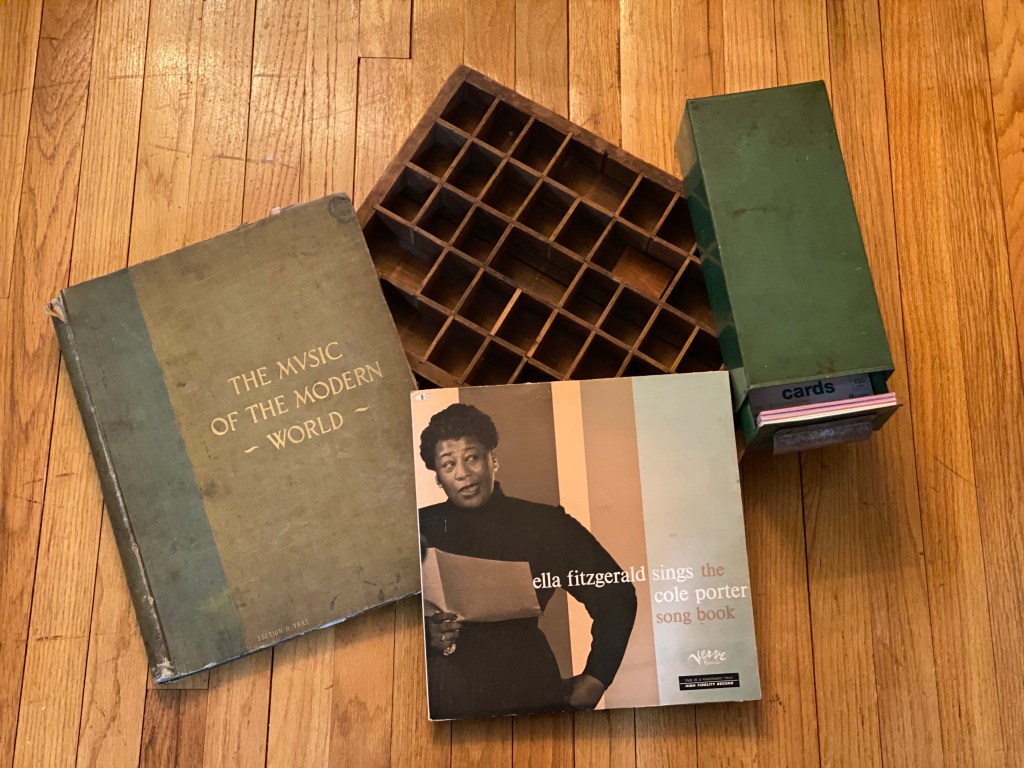
Image Contents: a few of my favorite vintage treasures. An Ella Fitzgerald record and file card box which have homes in my living room, so they’re staying; a letterpress tray and vintage music encyclopedias which do not, so they’re heading off to their new homes.

Week 6, Day 3: Onions, Old Habits and Grace

Even though minimalism experts like Joshua Fields Millburn  and Joshua Becker talk about their  decluttering process taking about three-quarters of a year, and other experts describe decades-long journeys, I figured six weeks should be enough time to get my house to clutter-free-a-place-for-everything-and-everything-in-its-place status. I mean, I’m not a hoarder. I don’t have a storage unit. My basement is a disaster, but I can park in the garage. Usually.

When I started, I felt I landed pretty squarely in the “normal” range of clutter, on the scale I made up. In my head. Based basically on my house not looking like either an episode of Hoarders or a minimalist magazine cover. 

So today, six weeks into my decluttering journey, when I went to put a few things away and realized they didn’t have an easy permanent home, I was frustrated at myself. And when I gathered up a few things in a tote to “deal with tomorrow,” I felt guilty and ashamed. Hadn’t I just learned the lesson of “do it now” yesterday?

When am I going to reach the point of everything having a home and automatically putting it there?

Then I remembered two things. First, the “onion method.” Different people have different versions of what this means, but the concept always revolves around layers. Sometimes the layering is in a single decluttering session – like yesterday when Dana K. White’s method started with trash and the easy peasy stuff, then kept going through harder items.

Sometimes uncovering the layers happens over time.

A month ago,  I decluttered my reusable grocery bags. Today I went grocery shopping and realized, since I’m not stocking up on grocery items as heavily, I’m shopping for less, and therefore don’t need as many bags as I had narrowed it down to a few weeks ago.

I started with what I thought I needed, then was able to peel back more. 

The same thing is happening in the rest of my home. As I enjoy the benefits, see how I’m actually living, and build up my decision-making muscles, I’m often decluttering things as I come across them, and sometimes intentionally going back to spaces I know can function better with less. 

I also realized everything not yet having a place for everything and putting a few things in a tote for tomorrow is not failure. There’s grace in the process. After all, I have a whole other week before my self-imposed deadline. 😉

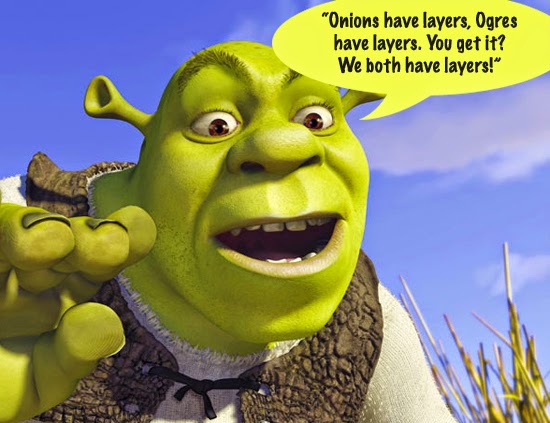
Image Contents: an image of Shrek saying, “Onions have layers, Ogres have layers. You get it? We both have layers!” Because I can’t talk about onions having layers with Shrek and Donkey busting into my head.