So, here’s one of the benefits of growing older: In a lot of areas, you know what you like, what works for you, and what doesn’t.
It doesn’t mean you can’t try new things – in fact a lot of studies say trying new things is an important part of staying mentally and emotionally and even physically healthy – but there are some things we don’t have to waste time making decisions about.
I know what sunscreen works for my face. I have extremely sensitive skin and there are roughly 2 brands of sunscreen/moisturizer/face cream I can put on my face without pain or massive breakouts.
I also know heavy, volume pumping hair products weigh my hair down and just don’t work for me.
And yet cleaning out my health and beauty supplies today, I found numerous different brands of face creams that I tried when I didn’t want to spend the money on the brand I know works.
I found bottles of hair volumizing products I purchased thinking…what? This time they would magically give my hair new life?
Removing these not only makes room in my closet, it also limits the millions of tiny decisions I make. I don’t have to dig through piles of moisturizers in my linen closet or stand in the store trying to sniff new shampoo scents through a mask. For many of these things, I already know what works for me.
It was one of my favorites as a child, and one of my favorites to read to my own children – probably in part because I love Maurice Sendak’s illustrations. In the chapter, “What Will I Wear,” Little Bear looks out the window at the falling snow and even before he steps out into it, he tells his Momma, “Momma I’m cold, I want something to put on.”
Momma Bear sews him a hat and sends him out to play in the snow.
Soon he returns, still cold. His Momma gives him another layer and sends him back out.
Every time he goes out to play, he comes back, asking for more, and every time his Momma puts down what she is working on and sews him another layer – a hat, then a coat, and eventually even snow pants. Still, Little Bear returns cold.
Finally, Momma Bear stops and considers all that she has put on him. She offers Little Bear one last solution, a fur coat. YES, says Little Bear. But instead of adding another layer, one by one she removes all the layers she had covered him with that day.
Look, at your fur coat. Now you will not be cold, she told him.
And he wasn’t.
All Little Bear needed was the fur coat he was born with. It was enough, and every layer added detracted from it.
Throughout this uncovering project, I can see spaces in my home, and my life, filled with my own versions of those hats, snow pants, etc.
How many times have I seen my kids be interested in something and respond by burying them under a mound of supplies I think they may “need” to pursue that interest, completely overwhelming them and stifling creativity instead of nurturing it?
How many times have I tried to solve problems by buying more stuff, adding more layers?
Then the even harder questions:
What are the layers that have been put on me, and I have put on myself, and others, to make me and/or my spirituality ‘enough?’
I asked a few friends who grew up in the church to share things they were told were expected of them as ‘christian’ women. From their experiences (and mine), we have been told, to be a ‘christian’ woman, we must:
Cook Sew Entertain Be quiet Be friendly Be kind Be generous Always be prepared to give an answer to explain your faith Don’t preach or teach Hide your doubts Dress modestly Attract a husband Praise (and defend) your husband Have children Take care of the children Teach Sunday School Keep the children quiet too Braid your hair Don’t be concerned with braided hair Proverbs 31 in the streets and Song of Solomon in the sheets Be submissive, be a helpmate
Some of the things on this list may perhaps lead to women who are more well-behaved (in some people’s minds and according to some people’s standards). Some of these things may even make some women feel more well-liked or accepted (in certain circles).
But many of the items on this list are far too often used as tools of control and manipulation, perpetuating toxicity and abuse in many church communities.
As a follower of Christ, I believe I am to be continually growing and maturing, following the example of Christ. This list, however, does not make us Christian or make us any more or less loved by God.
Like Little Bear, each successive layer just makes us colder, as they cover up how we were created to thrive. The uncovering process I’m engaging in, the search for real, is the hard work of stripping away all the layers of human expectation, often one by one, to reveal my perfectly designed fur coat, which has been hiding underneath the entire time.
I planned on going through my stash of hammocks and blankets and outdoor supplies I keep in my car during the Spring/Summer/Fall, but to get to those, I would have had to move kayaks and other big equipment in the garage and the temp went above 50 for the first time in what felt like 10 years today, so other than a quick pass through the games and things I regularly keep in my car, I skipped the decluttering today. Because the point is to uncover real, and to live life fully and when the sun is shining and jackets are unnecessary, life is often better spent walking with a real friend and a real cup of coffee than wrestling with kayaks in a windowless garage.
No photo today. I was too busy enjoying the sunshine on my walk to remember to take a picture.
In his Becoming Minimalist email this morning, Joshua Becker encouraged his readers to consider Spring Decluttering instead of simply Spring Cleaning. In his list of tips, he suggested asking yourself questions like “what would I use if I didn’t have this item?”
I asked the same question while evaluating my craft supplies this past week, forcing myself to consider if the item I was looking at was the only way I could accomplish a given task.
Today, I read the question differently.
I had already scheduled technology for my category of the day, and was planning on looking at our devices, electronic games, piles of random cords, etc.
As I pondered “what would I use if I didn’t have this item” in terms of my electronics, the question took on a whole new meaning:
What activity or task would I be able to complete if I wasn’t playing this game?
What interaction would I engage in if I wasn’t interacting with this technology?
Don’t get me wrong, I think there is a place for numerous kinds of technology and screens – including video games. Over the past year, all four of us were able to attend school because we had our devices.
Some video games have been proven to be helpful in fine motor and some gross motor skills. Video games can be great tools to build relationships, especially in otherwise potentially awkward situations.
They have also been linked to all sorts of anti-social and problematic behaviors.
I listened to a Ted Radio Hour about Play a couple years ago and one of the featured speakers shed some light on one possible explanation for the difference between the positive benefits and potentially dangerous outcomes associated with video games. (The entire episode is fabulous, IMO, but if you want to skip to the section where they cover this concept, it starts around 35:15.)
They suggested why you play the game matters. If you approach screen time as entertainment or an interactive group activity, it can be enriching and relaxing. If you approach screen time as an escape, a means to not deal with your emotions, your responsibilities or the world around you, it can lead to unhealthy outcomes. (While I haven’t spent much time researching this, I imagine the same principle holds true for many other activities, not just screens. Books, food, exercise, even relationships approached as a means of escape can also lead to unhealthy outcomes.)
So back to Becker’s question, “What would I use if I didn’t have this item?”
If my children and I didn’t have our laptops, going to class and other tasks would be a lot more difficult, especially during this pandemic season. They’re a keeper. (I meant the laptops, but the kids, too.)
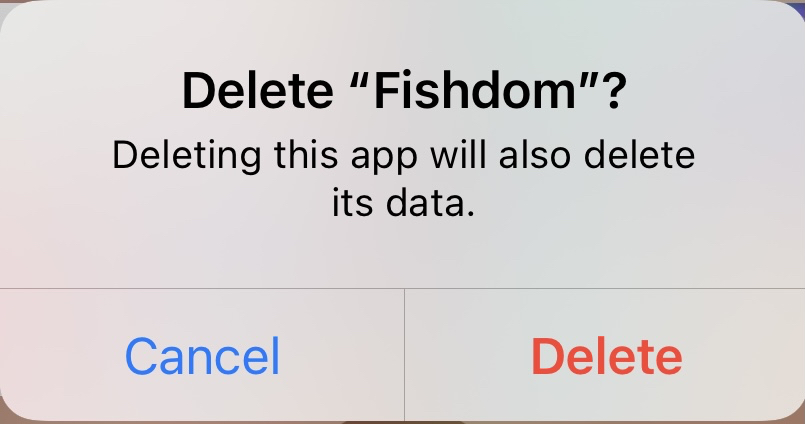
If I didn’t have the game Fishdom on my phone, I’d probably be less tempted to open it up and beat a few levels before starting on dinner. Or I might be more apt to read some of the books that survived the cut yesterday. I’m all for entertainment and times of relaxation, but hundreds of levels in, I think my relationship to Fishdom has breached the line to escapism. Buh-bye.
Note: I am very mindful of the many people who do not have adequate tools (including private spaces) to engage in school, work and other activities well in this current environment. We are extremely grateful for our sufficient technology, housing, food, and other met needs and wants, especially during this pandemic. We have also supported a couple organizations we love who are doing incredible work to lessen the disparity gaps in our culture which COVID-19 has significantly widened. If you’d like to learn more, send me a message or drop a question in the comments.
This week I’m focusing on “How I Eat” – everything from my dishes, to the space I cook in, to what I buy and how I prepare to eat.
My process has developed a rhythm:
Pull everything out of its home and make a pile in the middle of the room Begin to evaluate Suddenly remember where I have stored more items in this category Retrieve those items and add them to the pile Begin evaluating again Bag/box up culled pieces Return surviving items to their homes and try to figure out how on earth they all fit before
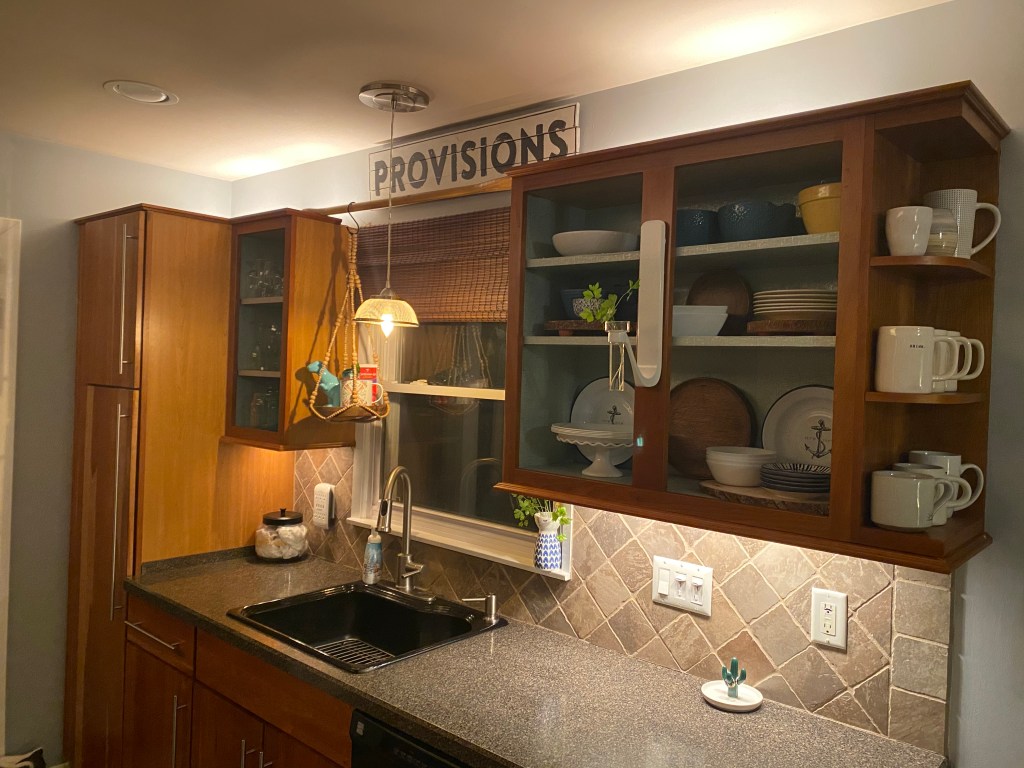
Today is dishes – plates, cups, serving pieces, etc. and my process was the same. Empty everything from my cabinets onto the kitchen table. Remember that I have dishes stored in the basement. (I may have progressed to keeping all seasons of clothes in my room, but my dishes still swap out of basement storage from the Friday after Thanksgiving till sometime after New Year’s.) Retrieve basement dishes. Begin process again. Send children to round up the stacks of dishes stashed in their bedrooms and other places. Wait for them to wash and dry those dishes. Begin process again.
Most of the actual evaluation process centered on recognizing where I really am in this season of life. I keep 20 dinner plates in my cabinet. I had also been storing a set of inexpensive china, my Christmas dishes and assorted other pieces like the melamine plates I pull out for summer parties. I bought those 20 dinner plates because there was a time in my life when it was not uncommon to have at least that many people over for dinners and parties. Now is not that time. I think it’s been at least two years (well before Covid) since I’ve hosted more than 10 people. The only thing 20 dinner plates in my cabinet accomplishes now is helping my kids get away with stashing plates in their room for way longer than I want to think about. Especially now that we don’t have a dishwasher, I want to limit my dishes so we get in the habit of washing, drying and putting away our own dishes immediately. Well, that’s the goal, anyway. #dreamBIG.
I recently donated the china. It wasn’t something I felt like I needed to keep dedicating space to. As for the Christmas dishes, I realized over the last few years, I’ve been bringing up my dinner plates and a small sampling of other pieces – not the whole collection – to mix in with my everyday white dishes. It gives the festive touch I like without me spending a day swapping and washing an entire cabinet full of dishes. So I’m donating everything but those pieces I’ve already been prioritizing.
I’m not ready to say I’m done with larger gatherings at my house, so I kept a handful of plates and bowls in my cabinet and moved the rest to the now emptier cabinet in the basement housing my Christmas dishes.
Nothing today was earth shattering or drastic, but when I went to serve dinner tonight, I grabbed a serving bowl from the cabinet. I didn’t grab a serving bowl and remove all the bowls stacked inside it. I didn’t move something out of the way to grab the serving bowl. I just reached up and grabbed a serving bowl. That moment (and all the times it will be repeated) was worth the day’s work.
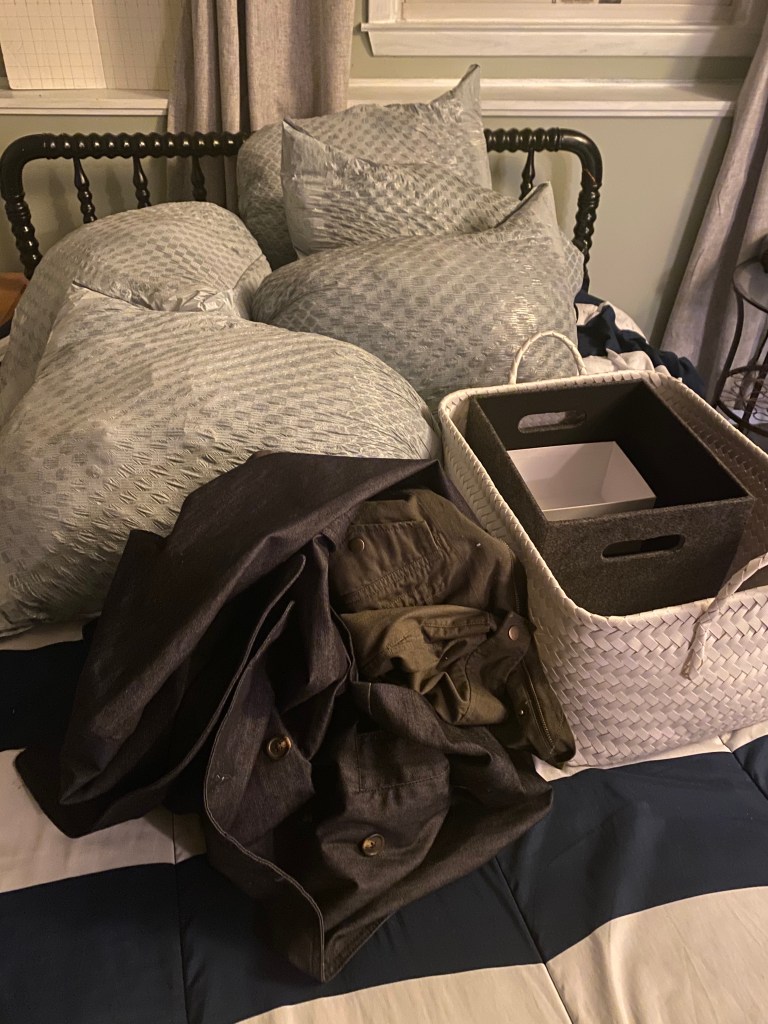
Yesterday I went through a trunk in my room storing clothes that are too small for me. As I pulled each item out, I thought about it. Was I holding onto that dress because I really liked it, or because I really like the memory of the amazing backyard bridal shower my step-sister threw? Do I like this sweater, or just that fabulous restaurant where I wore it? Do I really need to hold on to these?
I kept a few things – a few fancy dresses I wasn’t ready to part with, a few summer dresses I’ll revisit as the weather gets warmer. Between that purge and the few days before, I piled up 5 garbage bags for donation and another of trash.
It felt a little horrifying to see. It felt more horrifying to walk back and see everything still full. A few things moved from the drawers to the closet to make room for specialty things like bathing suits and painting clothes in the dresser. There’s still some coats in the coat closet. Still plenty of clothes in my closet and drawers. Still jewelry in my jewelry drawer after decluttering today and I’m sure there will still be shoes, purses, hats and headbands tomorrow after I review my accessories.
But when I walked into my room for something today, it felt lighter.
I didn’t place it at first. It just kept catching me. Like catching a breath.
And that’s what it was.
Room to breathe.
It’s not just that my closet and drawers reflect what I really like, the items in them also have space to breathe, not straining and stressing against their spaces. And so do I.
OK, so I’ve made the decision to look at my house and stuff through this season of Lent, using the lens of “real” by asking questions like:
How do I really feel when I step into this space? Why did I really buy this? Why am I really keeping this? What image did I really hope this would project about me?
But how? Now what? Now I actually have to DO something.
There are about six weeks until Holy Week, so I’ve chosen six general areas to examine – categories where I know I have stuff hidden away that I want to address (read: really don’t want to address):
-What do I wear? -How do I eat? -What activities do I engage in? -What do I stock up on? -What do I store with no current purpose? -What memories am I holding onto?
I’ve decided against room-based categories because I don’t necessarily keep all like things together in the same room and I don’t want to give myself the out of not addressing something just because it’s not in the room I’m focused on.
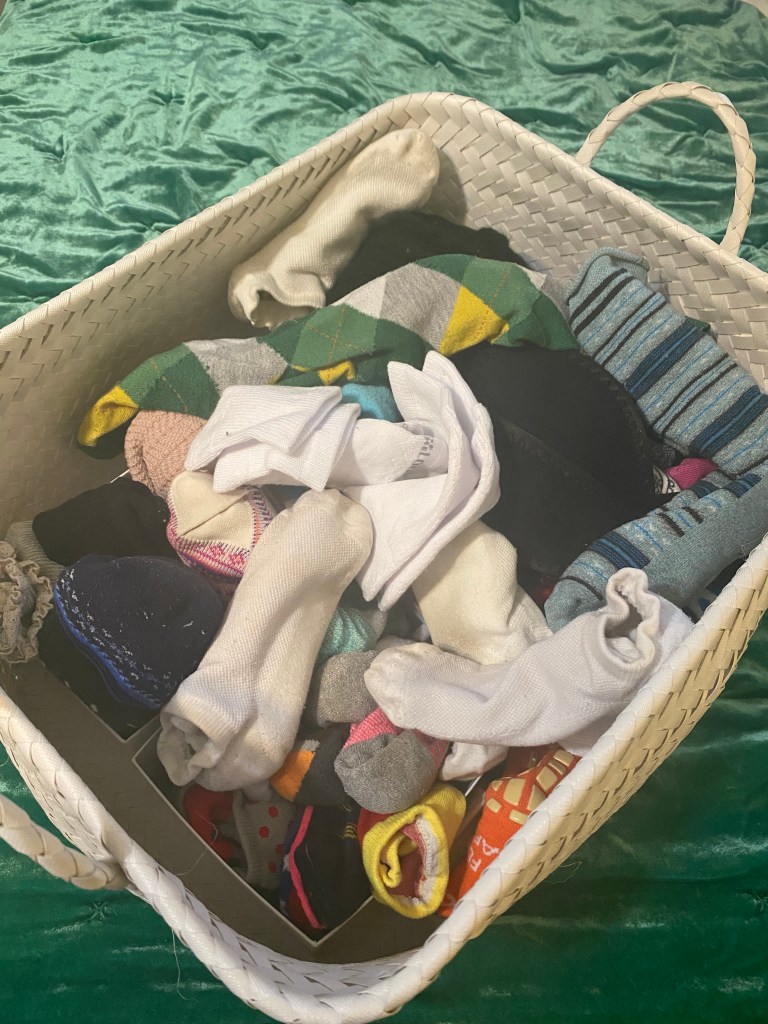
I’m going to start with “What do I wear” for a couple reasons. First, I think we all have clothes. Second, I’m writing at a desk in my bedroom, so clothes are pretty much right.in.my.face. Third, clothes are really easy. and they’re really hard. Getting rid of a pair of socks with holes in it can be zero effort, but clothes can also be weirdly emotional, right? So, whether you respond best to starting a project with the easy, embracing the snowball effect (like this), or respond best to starting your day by eating a frog (concept dubiously assigned to Mark Twain here), clothes are both.
For me, I respond best by having something else to do. For all you personality test junkies, I’m a Myers-Briggs ENFP and the most accurate thing I’ve ever read about ENFP’s is that it is amazing what we’re capable of accomplishing…..when we’re supposed to be doing something else.
Like right now.
Perhaps I need to stop writing about decluttering what I wear and go face my closet. My holey socks are waiting.
Check in on Facebook and Instagram throughout the week, I’ll be posting some photos of actually decluttering the things I wear.


 Uncovering Real