The Raccoon Rule

I was reminded of why I declutter through an unexpected visitor this week.

A very unexpected visitor.

Early one morning, I woke to some commotion in the kitchen. Assuming it was a child, I went to check it out  but instead of a child, I  found our living room window screen pushed in and several items from the counter between the kitchen and living room scattered across the floor.

After catching my breath and calling my husband out, we discovered the cutest little bandit I’ve ever seen had broken in, stolen a scone off the counter, and was now sitting on the deck, happily unwrapping and eating her bounty.

Meet Buttercup:
(Bonus points if you know the reference to the Queen of Refuse, the Queen of Garbage.)

Our Raccoon Bandit

Once we made sure there were no more critters hiding in the house and re-secured the window, I looked at the chaos Buttercup had left behind. I was grateful the mess wasn’t worse. Keeping my house from getting out of control definitely helps make unexpected situations like these easier to deal with!

But there was still a mess to deal with. A tray she knocked to the floor had held our HomePod speaker and a few sentimental keepsakes: a set of ceramic ducks from my grandmother, who passed away last year, and George, a clay monkey my daughter made in school years ago.

Two of the three ducks were shattered. George had lost multiple limbs.

As I stood there with broken pieces in my hands, I paused. 

You may have heard of the “poop rule” when it comes to decluttering:
“Do you like this item enough that you’d clean poop off of it to keep it?”

Well, I now had a new version: The Raccoon Rule.
Would I clean, fix, and keep something a raccoon got her paws on?

It was tempting to toss them out. They were damaged. The mess was inconvenient. But these weren’t just random knick knacks – they were items I had chosen to keep.

And that’s the heart of decluttering for me.

My decluttering isn’t really about getting rid of stuff.
It’s not about what I’m losing.
It’s about what I’m keeping.
And what I’m gaining, including the joy from seeing our memories displayed around us. 

I had kept those items because they are filled with happy memories — sweet treasures that make me smile when I see them.

So I picked up the pieces, sanitized them, and plan to glue them back together.

Decluttering, to me, has never been about living with nothing.
It’s about living with intention.
It’s about creating a space that is manageable, and it is also about creating space for what matters – and having room to appreciate the joy in what stays: 

Like a one-armed clay monkey named George, who now has a few scars and a great story to tell.
Side Quests and Signal Flares

When I feel stressed I like to reorganize my closets.

Especially my master bedroom closet.

Weird? Maybe. Pointless? definitely not.

It can be a helpful process.

I can feel accomplished at the end. Like a good painting project, I can look at my room at the end and say, “I did that.”

But in order to say “I did that” – it needs to actually get done. 

I have a tendency to embark on projects with uncontained enthusiasm. I start strong, either motivated by a goal (“Today’s the day I get this basement ‘organized’”) or motivated by an emotion (any stress or rage cleaners out here?)

Orrrr

I start on a project because in the moment it seems like an absolutely necessary side quest from the path I’m on. Like, I’m getting dressed but can only find one of this earring set? Why wouldn’t I dump out every piece of jewelry I own and start reorganizing the whole system until I am sitting on the floor half dressed, surrounded by 30 carefully sorted piles of jewelry, completely out of energy, and 17 searches deep on the Best Jewelry Storage Systems on TikTok and Amazon?

Actually, that’s the path most of my projects tend to take. Big energy start, a swirl through overthinking and distraction, then an overwhelming crash that leaves me with a bigger mess than I started with.

Not exactly a remedy for stress and uncertainty. 

And when I’m stressed, I like to reorganize my closets. Notice a pattern?

Stress leads to action, which feels productive – until it spirals. I want to feel in control, so I dive into something I can control. But then the thing I thought would soothe me ends up adding to the chaos.

I’m learning the urge to reorganize is a flag – a signal that something inside me is asking for attention, for care, for clarity.

Lately, I’ve been trying to pause when I feel this signal flare. Instead of pushing through, I’ll ask myself: “What did I really need when I started this?” 

Sometimes it’s control. Sometimes it’s rest. Sometimes it’s just a sense of forward motion.

And sometimes it’s a better system for managing my bedroom closet. And that’s ok, too.

(check out pictures of my latest bedroom closet side quest on Instagram)

Week 3, Day 4: Books

Of all the lectures and books and coursework I was involved with over the last couple years as I finished my undergraduate degree, one little line in a Speech class lesson on proper citations sticks with me perhaps the most strongly. The author of the book was underscoring the need to include dates in citations and his reasoning was “experts sometimes change their mind, so currency is important” (Rothwell, 2016).

The statement was incredibly freeing for me. 

Experts sometimes change their mind.

Maybe new evidence came to light. Maybe something caused them to see things from a different perspective or through a new lens.

And if even experts sometimes change their mind, maybe it’s ok if I do sometimes, too.

Before I had kids, I knew all sorts of things about parenting. New evidence has come to light. 😉

Listening to authors from different backgrounds, cultures and experiences has also led me to see some things through a new lens. 

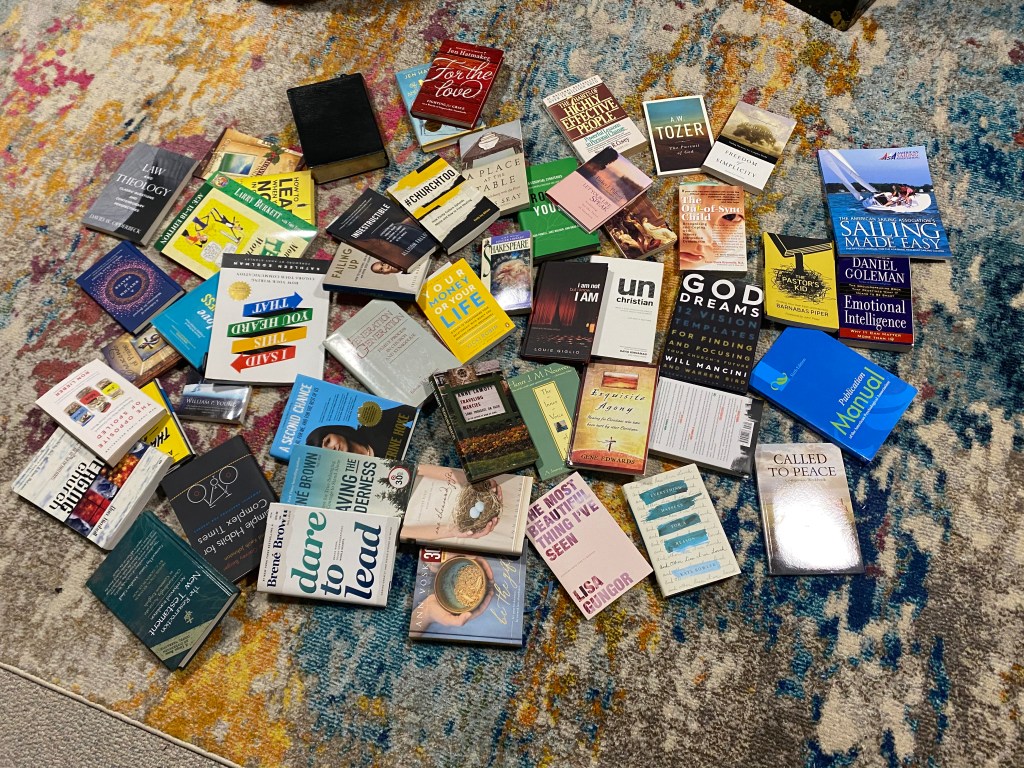
As I looked through my array of books, I saw authors who I once agreed with, who I now question. I saw books filled with ideas I have questioned in the past but reading other perspectives has made me evaluate my own beliefs – sometimes resulting in me adjusting my beliefs, sometimes resulting in me recommitting to my original beliefs more strongly. 

Some books I held onto because I have referenced them numerous times and likely will again. Some I passed on because I decided if I ever read it again, I want to read it with fresh eyes, not constrained by the highlights and margin notes that are in my current copy. 

Some of them I want to sit with longer and some of them will stay because I want to continue to understand and perhaps be challenged by the perspectives they contain.

And some I just need to pass on because, like the CDs and crafts yesterday, I would need to live a hundred lifetimes just to get to it all. 

Citations

Rothwell, J. D. (2016). Practically speaking. New York, NY: Oxford University Press.

(picture contents: beginning to collect books from around the house for evaluation)