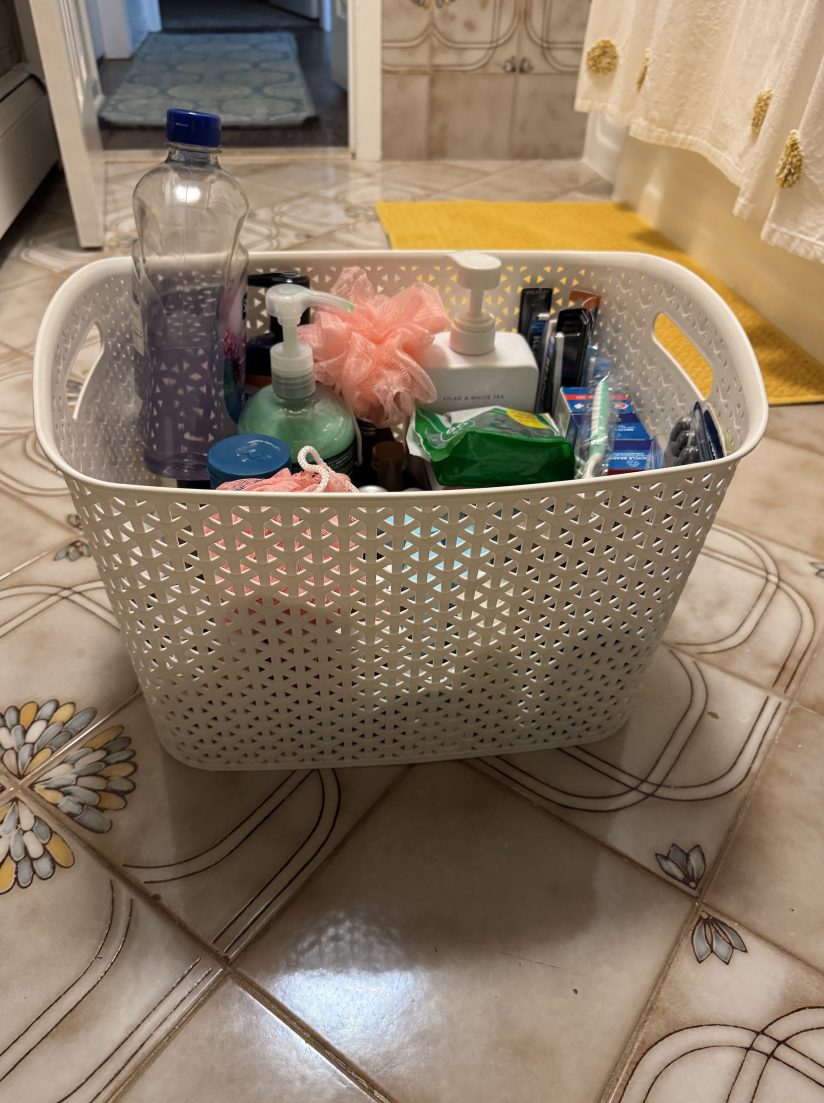
I keep a giant basket under the bathroom sink that holds our health and beauty “back stock”: toothpaste purchased on a “must buy three” sale, shave gel from a company you can only order from online (so might as well order enough to get free shipping)… you know all the deals.
I’m a sucker for a good deal. I used to be an avid couponer too, especially back when I was going through about a thousand diapers a week. I love watching the discounted price get calculated at the register like I imagine a gambler loves the feeling of beating the house.
And it’s not just the thrill of the win. I like feeling prepared. I feel like I have my life a little bit together if I know my family will never squeeze the last of the toothpaste onto their brush without a full tube ready and waiting just a few feet away.
But over the years, I’ve discovered there’s such a thing as too much of a good thing.
Products don’t last forever and can expire before I get to use them. Or something changes—like when I got older and needed to start wearing lotion with sunscreen every day, so the regular lotion I’d stocked up on just sat there, languishing.
For most things we use regularly, one backup works for us. When we use the last of the mayo, we pull the backup out of the pantry and put mayo on the shopping list for the week. Backup food goes in our pantry closet. Backup health and beauty items go in that bin under the bathroom sink. I still love a good deal, and if the deal is for 3 toothpastes we like (and the bin isn’t already overflowing) I’ll probably buy three.
Anything much beyond that? I’m learning the perfect place to store those extras.
I store them…
At the…
Store.
That’s what the store is there for.
I get it. We lived through the toilet paper crisis of 2020. There’s a lingering fear of not being able to access what you need. But it’s a pretty rare week we don’t go to at least one grocery store. And if an emergency came up, I have countless stores between work and home, plus endless online options, not to mention any number of ways I could reach out for help to get what we need.
I don’t need Costco under my kitchen sink. Costco can keep my extras on their shelves. They can manage the cleanup if something accidentally spills and assign someone to check expiration dates. They can worry about the storage space.
And when I do run out and need to replace my backup? Chances are, it will be at the store, waiting for me.
I’ve ingested quite a number of books, blogs, podcasts and youtube videos on decluttering and minimalism. (Oh the irony of my consumption of minimalism media.)
I’ve gleaned a number of things which work for me (timers are an essential part of my routines) and things which don’t (no, I don’t think the answer to a messy house is to just stick everything you have in baskets).
There is one decluttering method I’ve come across in a few places. I hate almost everything about it. Except: it works really well and solves a lot of the problems I create for myself, and apparently it’s just about perfect for me. But, you know, other than that…
Mostly I don’t like it because it goes against how I usually declutter. But how I usually declutter leaves me exhausted and often leaves my house in worse shape than when I started, so… I decided maybe it was worth trying… for research.
The method is from Dana K. White of A Slob Comes Clean. She has multiple blog posts, youtube videos and books detailing what she’s learned over the past decade or so of her journey, I’m just going to highlight her method of “decluttering without making a bigger mess.”
Here’s what she says you need to get started:
1st: a donate-able donations bag/bin. (so you can just put the whole bag in the car and drop it off at a donation center.)
2nd: a garbage bag
3rd: your feet or someone helping you if you need assistance (yeah, it’s a little cheesy, but she’s going somewhere with it, so I’m including it)
During your decluttering session you’re going to stick to a small, defined area and ask yourself two questions as you go:
If I needed this item, where would I look for it? (take it there. now.)
If I needed this item, would it ever occur to me that I already have one? (If not, get rid of it because I’d just buy a new one if I needed it.)
It’s her parenthesied directions that get to me:
Why would I take it there immediately? It breaks up the process! I’d get distracted! I can’t imagine how tired I’d be if I stopped with every item to put it somewhere else and came back! I’ll just make a pile as I go.
The second question is not as difficult for me, but I still feel the arguments rise up inside: What a waste of money! It’s a perfectly good item! Why would I buy a new one when I have one?!
But I tried it anyway.
Normally my decluttering process is more like:
dump everything out. sort every single item. get distracted. come back. look through the piles to remember what the sorting method was. get distracted. come back. finish sorting everything. feel accomplished but tired. look around and see scattered piles of donate, garbage, keep, bring to another room, etc. feel overwhelmed and frustrated with myself.
Sometimes the piles would get addressed right then. Sometimes I’d need to move on to something else and the piles would linger, becoming magnets for more clutter and more frustration.
So today, I picked one drawer and implemented the rules. She encourages you to start with the easiest stuff – usually trash. I didn’t have any obvious trash in the drawer, but found plenty of things which needed to be delivered to other places. I love her first question because it’s totally real, not aspirational and unattainable. You’re not designing a whole organizing system and creating places for something. You’re acknowledging how you actually operate. If she asked me where my favorite multi-bit screw driver belongs, I might be tempted to think about places on the workbench I should keep it. When she asks where I would I look for it, my immediate answer is, “the kitchen drawer.” Ok, so don’t beat yourself up over whether that’s the right answer or not, go put it in the kitchen drawer! If there’s not room in the kitchen drawer, get rid of one thing in the kitchen drawer and now you have room.
I still found it hard to deliver the items immediately. I was tired. I repeatedly found myself going to make a pile of something. But I forced myself to do it – looking around first to see if there was anything else I could take at the same time to save a trip. At one point the phone rang and I left to go answer it somewhere else. When I came back to the drawer, all that waited for me was an empty garbage bag, a partially filled donate bag and progress. Nothing totally dumped out. No piles. No mess. I could walk away right then and it would be better than I started.
This is the beauty of Dana’s method. You’re always at a stopping point and your stopping point is always better than when you started.
So like I said, I hate almost everything about it. Except it works really well, solves a lot of the problems I create for myself, and apparently it’s just about perfect for me.
Image Contents: What my spaces often look like AFTER I declutter – random piles of stuff that need to be delivered to other places, often tossed in bags that sit in the hall or basement until I set aside time to deal with the items inside. again.
Of all the lectures and books and coursework I was involved with over the last couple years as I finished my undergraduate degree, one little line in a Speech class lesson on proper citations sticks with me perhaps the most strongly. The author of the book was underscoring the need to include dates in citations and his reasoning was “experts sometimes change their mind, so currency is important” (Rothwell, 2016).
The statement was incredibly freeing for me.
Experts sometimes change their mind.
Maybe new evidence came to light. Maybe something caused them to see things from a different perspective or through a new lens.
And if even experts sometimes change their mind, maybe it’s ok if I do sometimes, too.
Before I had kids, I knew all sorts of things about parenting. New evidence has come to light. 😉
Listening to authors from different backgrounds, cultures and experiences has also led me to see some things through a new lens.
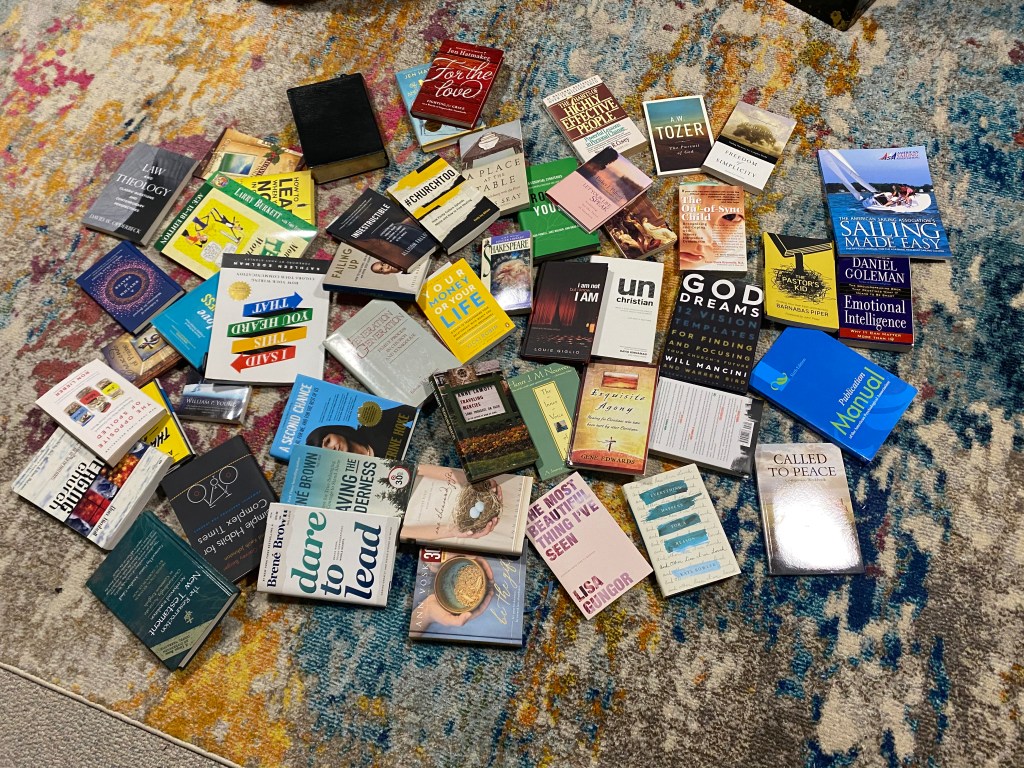
As I looked through my array of books, I saw authors who I once agreed with, who I now question. I saw books filled with ideas I have questioned in the past but reading other perspectives has made me evaluate my own beliefs – sometimes resulting in me adjusting my beliefs, sometimes resulting in me recommitting to my original beliefs more strongly.
Some books I held onto because I have referenced them numerous times and likely will again. Some I passed on because I decided if I ever read it again, I want to read it with fresh eyes, not constrained by the highlights and margin notes that are in my current copy.
Some of them I want to sit with longer and some of them will stay because I want to continue to understand and perhaps be challenged by the perspectives they contain.
And some I just need to pass on because, like the CDs and crafts yesterday, I would need to live a hundred lifetimes just to get to it all.
Citations
Rothwell, J. D. (2016). Practically speaking. New York, NY: Oxford University Press.
(picture contents: beginning to collect books from around the house for evaluation)
This week I’m focusing on “How I Eat” – everything from my dishes, to the space I cook in, to what I buy and how I prepare to eat.
My process has developed a rhythm:
Pull everything out of its home and make a pile in the middle of the room Begin to evaluate Suddenly remember where I have stored more items in this category Retrieve those items and add them to the pile Begin evaluating again Bag/box up culled pieces Return surviving items to their homes and try to figure out how on earth they all fit before
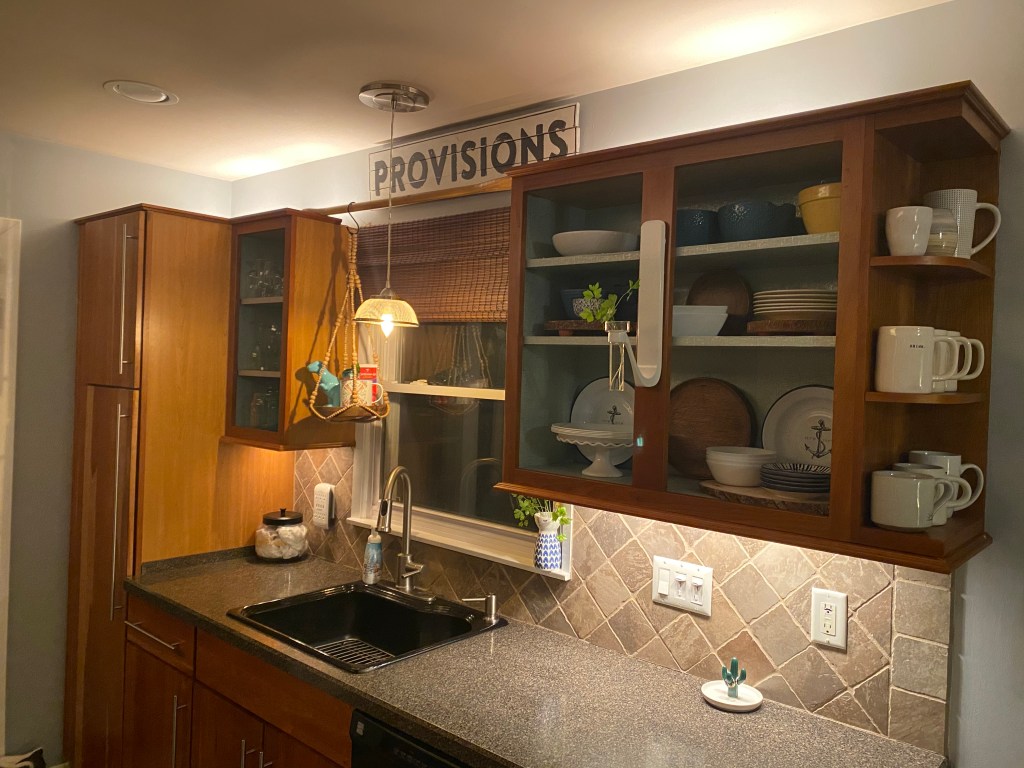
Today is dishes – plates, cups, serving pieces, etc. and my process was the same. Empty everything from my cabinets onto the kitchen table. Remember that I have dishes stored in the basement. (I may have progressed to keeping all seasons of clothes in my room, but my dishes still swap out of basement storage from the Friday after Thanksgiving till sometime after New Year’s.) Retrieve basement dishes. Begin process again. Send children to round up the stacks of dishes stashed in their bedrooms and other places. Wait for them to wash and dry those dishes. Begin process again.
Most of the actual evaluation process centered on recognizing where I really am in this season of life. I keep 20 dinner plates in my cabinet. I had also been storing a set of inexpensive china, my Christmas dishes and assorted other pieces like the melamine plates I pull out for summer parties. I bought those 20 dinner plates because there was a time in my life when it was not uncommon to have at least that many people over for dinners and parties. Now is not that time. I think it’s been at least two years (well before Covid) since I’ve hosted more than 10 people. The only thing 20 dinner plates in my cabinet accomplishes now is helping my kids get away with stashing plates in their room for way longer than I want to think about. Especially now that we don’t have a dishwasher, I want to limit my dishes so we get in the habit of washing, drying and putting away our own dishes immediately. Well, that’s the goal, anyway. #dreamBIG.
I recently donated the china. It wasn’t something I felt like I needed to keep dedicating space to. As for the Christmas dishes, I realized over the last few years, I’ve been bringing up my dinner plates and a small sampling of other pieces – not the whole collection – to mix in with my everyday white dishes. It gives the festive touch I like without me spending a day swapping and washing an entire cabinet full of dishes. So I’m donating everything but those pieces I’ve already been prioritizing.
I’m not ready to say I’m done with larger gatherings at my house, so I kept a handful of plates and bowls in my cabinet and moved the rest to the now emptier cabinet in the basement housing my Christmas dishes.
Nothing today was earth shattering or drastic, but when I went to serve dinner tonight, I grabbed a serving bowl from the cabinet. I didn’t grab a serving bowl and remove all the bowls stacked inside it. I didn’t move something out of the way to grab the serving bowl. I just reached up and grabbed a serving bowl. That moment (and all the times it will be repeated) was worth the day’s work.

 Uncovering Real