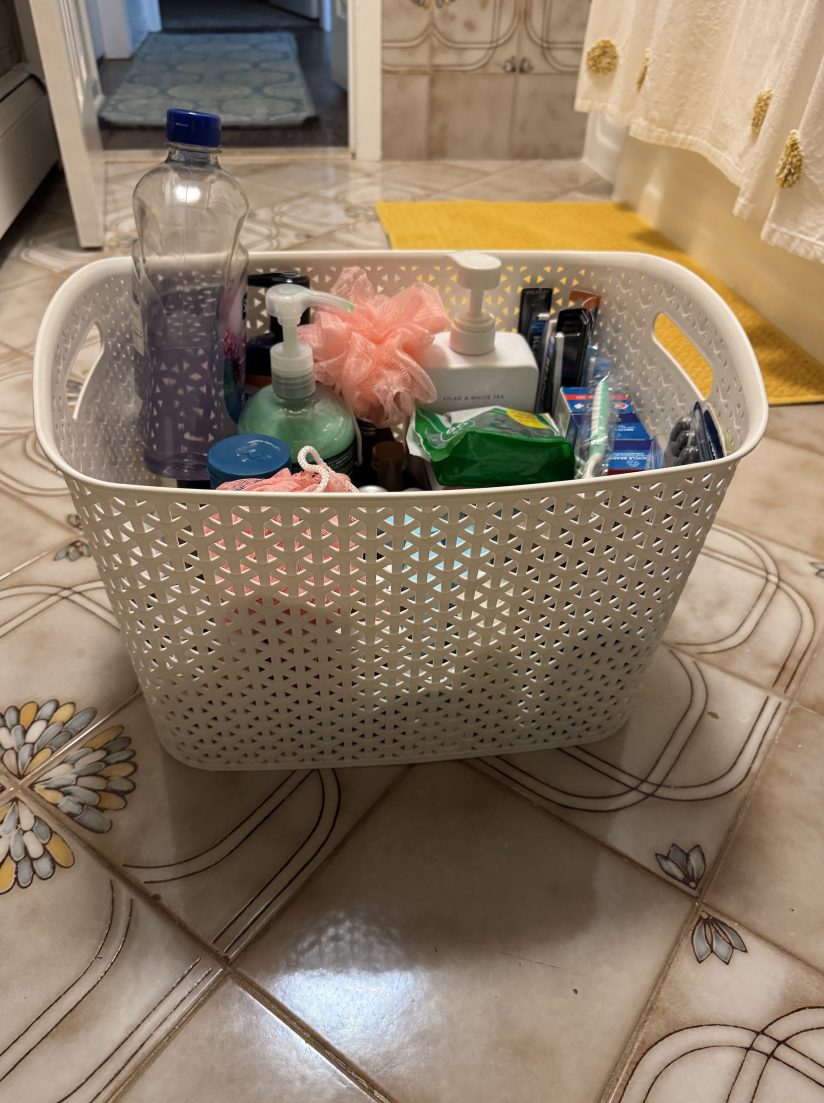
I keep a giant basket under the bathroom sink that holds our health and beauty “back stock”: toothpaste purchased on a “must buy three” sale, shave gel from a company you can only order from online (so might as well order enough to get free shipping)… you know all the deals.
I’m a sucker for a good deal. I used to be an avid couponer too, especially back when I was going through about a thousand diapers a week. I love watching the discounted price get calculated at the register like I imagine a gambler loves the feeling of beating the house.
And it’s not just the thrill of the win. I like feeling prepared. I feel like I have my life a little bit together if I know my family will never squeeze the last of the toothpaste onto their brush without a full tube ready and waiting just a few feet away.
But over the years, I’ve discovered there’s such a thing as too much of a good thing.
Products don’t last forever and can expire before I get to use them. Or something changes—like when I got older and needed to start wearing lotion with sunscreen every day, so the regular lotion I’d stocked up on just sat there, languishing.
For most things we use regularly, one backup works for us. When we use the last of the mayo, we pull the backup out of the pantry and put mayo on the shopping list for the week. Backup food goes in our pantry closet. Backup health and beauty items go in that bin under the bathroom sink. I still love a good deal, and if the deal is for 3 toothpastes we like (and the bin isn’t already overflowing) I’ll probably buy three.
Anything much beyond that? I’m learning the perfect place to store those extras.
I store them…
At the…
Store.
That’s what the store is there for.
I get it. We lived through the toilet paper crisis of 2020. There’s a lingering fear of not being able to access what you need. But it’s a pretty rare week we don’t go to at least one grocery store. And if an emergency came up, I have countless stores between work and home, plus endless online options, not to mention any number of ways I could reach out for help to get what we need.
I don’t need Costco under my kitchen sink. Costco can keep my extras on their shelves. They can manage the cleanup if something accidentally spills and assign someone to check expiration dates. They can worry about the storage space.
And when I do run out and need to replace my backup? Chances are, it will be at the store, waiting for me.
Like most of my possessions, I have curated my purses down from what I unconsciously collected over the years, to an amount somewhere between a maximalist’s dream and an amount that would still suffocate a minimalist.
In my bag collection, there’s: – my lunch bag that doubles as my work purse – a vintage airline bag that fits my iPad and flute (for when I’m singing/playing) – four other purses I use throughout the year – and a few specialty bags that I don’t use regularly, but still made the cut: a book bag, some evening clutches, etc.
Listen, I never said I was a minimalist. 🙂
Some bags are always ready to go. My singing bag and my lunch bag stay stocked because I use them for the same activities over and over. A long time ago, I created a little system for the less-used bags: I tucked them away with a single makeup bag filled with odds and ends I might want to toss in – like that super-slim hand sanitizer from a conference that perfectly fits into an evening clutch.
I once decided I could streamline getting ready and cut down on decision making by keeping my other purses stocked like my singing and lunch bags. I lined up my 4 everyday handbags and stocked each one with duplicates of my go-to items: tissues, chapstick, hand sanitizer, etc. I figured this way I could just grab and go.
But… not so much.
Every time I grabbed a bag, I ended up rechecking it anyway – wondering if I’d borrowed something from it or deciding in the moment I wanted a different flavor of lip balm (maybe a tinted one, because I’m fancy today). I always reshuffled. I spent more time getting ready than I would’ve if I hadn’t pre-stocked at all.
Then I saw someone online talk about their “purse box” – a small box in their closet where they dump everything out of their purse when they get home. The next time they go out, they take whatever purse they want, and re-pack from the box.
It hit me like a stroke of genius…even though I’d basically already been doing this with my evening bags for years.
What I realized is that this system fits how my ADD brain works: stockedish. readyish.
It’s the same reason I don’t usually prep whole freezer meals. Instead, I double up on cooked meat or roasted veggies, freeze the extras, and figure out later what I’ll use them for. I like being flexibly prepared. I want ease, but I need options.
Here’s why I think the purse box could work for me:
It lets me choose in the moment. The elements are ready, but I still get that spark of decision: which bag works with my day? Am I going to need to reapply sunscreen?
It keeps me connected to my stuff. For some people, re-touching every item might feel tedious. But for a brain like mine that struggles with object permanence, physically putting each thing into my purse helps assure me that I have it.
So this week, I’m trying the purse box.
Not because it’s the “right” system. Not because it’s aesthetic or efficient or something a professional organizer would recommend.
But because it makes sense to me.
It’s one more reminder that the best systems aren’t the ones that work in theory – they’re the ones that actually work for me, in real life, with my actual brain.
Even when it means creating a glorified junk drawer, because it’s not about doing what’s supposed to work. It’s about utilizing what’s really helpful.
I’ve ingested quite a number of books, blogs, podcasts and youtube videos on decluttering and minimalism. (Oh the irony of my consumption of minimalism media.)
I’ve gleaned a number of things which work for me (timers are an essential part of my routines) and things which don’t (no, I don’t think the answer to a messy house is to just stick everything you have in baskets).
There is one decluttering method I’ve come across in a few places. I hate almost everything about it. Except: it works really well and solves a lot of the problems I create for myself, and apparently it’s just about perfect for me. But, you know, other than that…
Mostly I don’t like it because it goes against how I usually declutter. But how I usually declutter leaves me exhausted and often leaves my house in worse shape than when I started, so… I decided maybe it was worth trying… for research.
The method is from Dana K. White of A Slob Comes Clean. She has multiple blog posts, youtube videos and books detailing what she’s learned over the past decade or so of her journey, I’m just going to highlight her method of “decluttering without making a bigger mess.”
Here’s what she says you need to get started:
1st: a donate-able donations bag/bin. (so you can just put the whole bag in the car and drop it off at a donation center.)
2nd: a garbage bag
3rd: your feet or someone helping you if you need assistance (yeah, it’s a little cheesy, but she’s going somewhere with it, so I’m including it)
During your decluttering session you’re going to stick to a small, defined area and ask yourself two questions as you go:
If I needed this item, where would I look for it? (take it there. now.)
If I needed this item, would it ever occur to me that I already have one? (If not, get rid of it because I’d just buy a new one if I needed it.)
It’s her parenthesied directions that get to me:
Why would I take it there immediately? It breaks up the process! I’d get distracted! I can’t imagine how tired I’d be if I stopped with every item to put it somewhere else and came back! I’ll just make a pile as I go.
The second question is not as difficult for me, but I still feel the arguments rise up inside: What a waste of money! It’s a perfectly good item! Why would I buy a new one when I have one?!
But I tried it anyway.
Normally my decluttering process is more like:
dump everything out. sort every single item. get distracted. come back. look through the piles to remember what the sorting method was. get distracted. come back. finish sorting everything. feel accomplished but tired. look around and see scattered piles of donate, garbage, keep, bring to another room, etc. feel overwhelmed and frustrated with myself.
Sometimes the piles would get addressed right then. Sometimes I’d need to move on to something else and the piles would linger, becoming magnets for more clutter and more frustration.
So today, I picked one drawer and implemented the rules. She encourages you to start with the easiest stuff – usually trash. I didn’t have any obvious trash in the drawer, but found plenty of things which needed to be delivered to other places. I love her first question because it’s totally real, not aspirational and unattainable. You’re not designing a whole organizing system and creating places for something. You’re acknowledging how you actually operate. If she asked me where my favorite multi-bit screw driver belongs, I might be tempted to think about places on the workbench I should keep it. When she asks where I would I look for it, my immediate answer is, “the kitchen drawer.” Ok, so don’t beat yourself up over whether that’s the right answer or not, go put it in the kitchen drawer! If there’s not room in the kitchen drawer, get rid of one thing in the kitchen drawer and now you have room.
I still found it hard to deliver the items immediately. I was tired. I repeatedly found myself going to make a pile of something. But I forced myself to do it – looking around first to see if there was anything else I could take at the same time to save a trip. At one point the phone rang and I left to go answer it somewhere else. When I came back to the drawer, all that waited for me was an empty garbage bag, a partially filled donate bag and progress. Nothing totally dumped out. No piles. No mess. I could walk away right then and it would be better than I started.
This is the beauty of Dana’s method. You’re always at a stopping point and your stopping point is always better than when you started.
So like I said, I hate almost everything about it. Except it works really well, solves a lot of the problems I create for myself, and apparently it’s just about perfect for me.
Image Contents: What my spaces often look like AFTER I declutter – random piles of stuff that need to be delivered to other places, often tossed in bags that sit in the hall or basement until I set aside time to deal with the items inside. again.

 Uncovering Real