Maundy Thursday Reflections

Jesus spent Holy Week decluttering.

I mean, as far as we know, he lived a pretty minimalistic life anyway, with no home and no real possessions that we know of.

Yet, he still spent Holy Week decluttering.

After his Palm Sunday donkey ride, Jesus went to the temple to clear out the obstacles which were getting in the way of worship. He overturned the tables of money changers and angrily shouted at the people exchanging goods.  The temple’s purpose had been covered over with materialism, judgementalism, racism and legalism, which blocked the way for other nations to come worship. Many people clung to those practices as essential parts of their religion. To Jesus, they were cluttering up the space and covering over what was real.

That’s the core of what decluttering and minimalism are about: clearing space for what is most important, making room for what you prioritize.

Jesus spent Holy Week making space for what was most important and clearing out everything in the way.

Today is the day traditionally known as Maundy Thursday, which means Command Thursday. Jesus entered the Passover Seder, a meal full of ritual and rules and reduced the rules down to one. He cut through hundreds of religious rules to bring focus to a single thought. A single command. A single example:

Clear the space. Keep it simple. Don’t get lost in all the clutter – just love others.

Love others the way I love you.

That is the focus, and that is enough.
On Wednesdays We Reflect: Week 6 Reflections

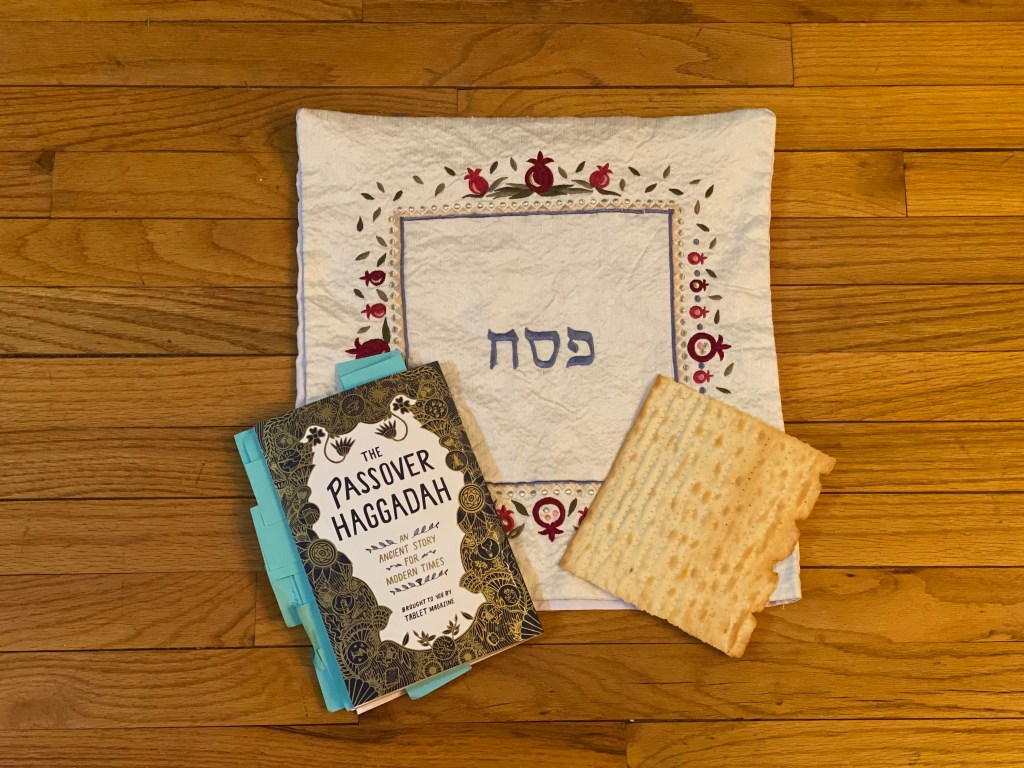
This past weekend, I hosted a Seder dinner. Like Lent, Passover and Seders have not traditionally been a part of my experience, so exploring the meaning and symbolism in each of them now opens up a bigger picture of God for me and a deeper understanding of faith. 

Passover, and the Seder dinner, rehearse and celebrate the story of God’s deliverance of the Israelites from their slavery in Egypt. Over and over, throughout the ceremony, participants are invited to insert themselves in the story. It is deeply symbolic and overwhelmingly sensory.

For our Seder, I purchased a new Haggadah, the order of service providing a framework for the Seder, and spent time studying traditional and contemporary interpretations of the celebration. The Haggadah I purchased includes a number of tips, background information, and reflections to help hosts prepare for, and lead, the evening.

In preparation for Passover, people spend days, even weeks, readying themselves for the Seder meal, removing every crumb of chametz (forbidden foods containing leavening agents) from their homes.

My new Haggadah reflected on those preparations:

“In this postmodern age, Passover is, in part, about doing something hard – not eating what you’re used to and what you sometimes desperately crave – perhaps to prepare us for the difficult work that liberation unfortunately requires. And while Passover is not formally the holiday during which we do the big accounting of our souls, many a rabbi urges us to ‘search for the meaning behind the mitzvah’ of ridding our homes of chametz. Removing it ‘from our homes, our lives, our families, is a struggle between who we really are now and who we can be once we strip away all the trappings of self-importance,’ according to one source…In this moment, what we are asked to do by our tradition is to enact and in a small way reexperience a communal decision to leave enslavement behind.”

As I studied the Haggadah, I realized this is exactly the process I’ve been engaging in over the last few weeks – 

The evaluation of the things in my home and my life

The struggle between who I really am now and who I can be

The journey from enslavement to freedom

The process of uncovering real. 

Over the next several days I’ll continue to process through Passover, and the remaining days of Holy Week here, exploring the concepts of enslavement and freedom. I hope you’ll join me.